>Something Beautiful

>

Photo Credit: The Buffalo News

It is so nice to see something as beautiful as this in the daily paper (which often seems to focus solely on the negative side of humanity). Pictured above is Gerda Klein–author, historian, crusader of tolerance, and Holocaust survivor–as President Obama places the Presidential Medal of Freedom on her. I find this image moving beyond words. To read the story in the Buffalo News, click here. To watch a 4-minute talk by Mrs. Klein, click here. To visit the Gerda and Kurt Klein Foundation website, click here.

“Ilse, a childhood friend of mine, once found a raspberry in the concentration camp and carried it in her pocket all day to present to me that night on a leaf. Imagine a world in which your entire possession is one raspberry and you give it to your friend.” 
Gerda Klein, from her memoir, All But My Life.

Things That Can Be Carried On A Bike (#271)

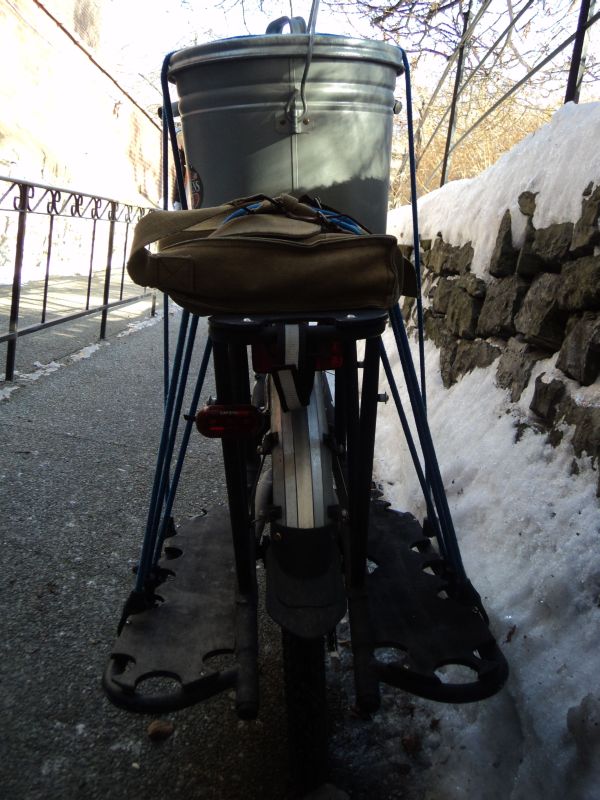
A 5gl. (19L) metal can full of ashes from my wood-burning stove (which I donated to a co-worker for her garden). A canvas bag containing, among other things, a semi-functioning netbook, an e-book reader containing approximately 157 books, an actual book, a day planner, and various writing implements.

>Things That Can Be Carried On A Bike (#271)

>

A 5gl. (19L) metal can full of ashes from my wood-burning stove (which I donated to a co-worker for her garden). A canvas bag containing, among other things, a semi-functioning netbook, an e-book reader containing approximately 157 books, an actual book, a day planner, and various writing implements.

Comfort Food

Beautiful isn’t it? The above photo is a slice of bread which I made the other day with just four ingredients.
For those of you who know me, or even those that just know me through this blog, you are probably aware that two of my favorite foods to cook are soup and bread. A person could subside on these two foods…and indeed some do I’m sure. They are the original comfort foods. And it’s something about this time of year–when winter begins to wane and we are a little weary of the cold short days–that these foods really hit home. Anyhow, tonight while I was looking for a recipe I came across the below article and thought it a good time of year to share it. The story originally appeared in Artvoice a couple years ago (click here to read it at their site).

Comfort food

Bread is an object of unparalleled worship and decorum. It embodies the full cycle of life and seasons, from the death of the wheat kernel in the earth to the resurrection as a stalk, from it’s ordeal in the mill to its journey through the oven and its offering at the table. Bread is a part of all major events in many lives, from birth, to betrothal and marriage, to death and resurrection.

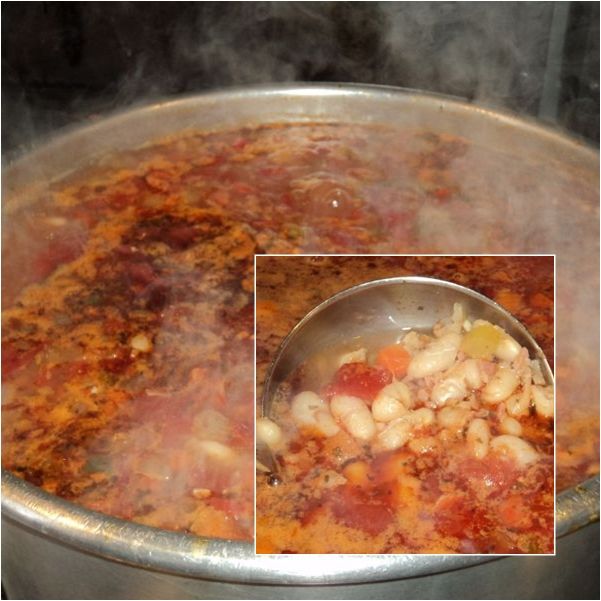
A few days ago I awoke to find that I had a cold. It was my own fault, I thought, for burning the candle at both ends and leaving myself susceptible. Intuitively I craved comfort food; soup, maybe some bread. I had a few vegetables in the refrigerator, but not nearly enough to make a hearty soup, and surly I was in no condition to go to the store. I figured there must be a few late-season vegetables in my small weed-infested garden. So I went out and rummaged. I hadn’t been back there for a while and was surprised to find more than enough vegetables. They seemed to be clinging to their withered plants in an attempt to ward of impending autumn. There were a surprising number of perfectly ripe tomatoes, and also some beans, a few ears of corn, a type of hard squash that I don’t remember planting, and even a couple small heads of cabbage. And this is how I happened to find myself wearing a bathrobe in my backyard with a runny nose and coffee cup in one hand and scissors in the other on a chilly morning in late September.

I had boiled a chicken the night prior but didn’t want meat in the soup, just the flavor, so I removed the chicken from its now cold and shimmering broth and put it back in the fridge for another time. I peeled the surface fat from the broth and put it on a flame to simmer and reduce a little, to intensify. While the broth began to move and swirl as it warmed I mixed a batch of sourdough. When I lifted the lid to the sourdough starter it made its usual “puff” sound, and it’s distinctively sour and yeasty smell filled the air. I could smell it even through my nasal congestion, or maybe it was psychosomatic and I just thought I smelled it. Either way, I enjoyed its aroma as I always do. After adding some starter and a few other ingredients to the mixer I fed the remaining starter and imagined the microscopic yeast gobbling up the fresh food…bread starter, the original virtual pet I thought, and one that I’ve nurtured and fed for more than 9 years. The late Parisian baker, Lionel Poilane, claimed that the starter from which all of his breads were leavened was more than a hundred years old, that it began with his grandfather.

Every culture has a name for naturally leavened breads; we call them sourdough because of the often sour flavor the fermenting grain produces. The French refer to them as pain au levain (risen bread, or bread with yeast); the French word for yeast is levure. The English word, leaven, and the French, levain, share the same origins. They stem from the Latin, lavare, meaning to raise. In fact, the Biblical lands of the Eastern Mediterranean, which is the birthplace of bread, share a related title for the land itself: the Levant, making reference to the sun rising in the east.

As the bread mixed I glanced at the starter, and scrawled on its container is 7/99, as in July 1999. To me the summer of 1999 seems like light years away yet at the same time just yesterday. Like a gold miner traveling north or a spiritual pilgrim going east, I’ve carried this starter with me through 3 residences in the last 9 years. Sometimes I’ve left it dormant in the refrigerator for months because I couldn’t muster the effort it took to care for it, much in the same way–I can now see in retrospect–that I too have retreated at times to dormancy for relief and rest. There were times when I left it the starter for so long in the refrigerator–months on end–that I didn’t think that I’d be able to resurrect it, but I have. There were also times in past years that I wondered if I myself would survive personal tribulations, but I have. After the dough had mixed I placed it in a brotformen (German bread rising basket), then went to task at cutting the vegetables.

I enjoy the paradox of both soup and bread: they’re made with the most basic ingredients but at the same time can also be two of the most nourishing foods; they can be the simplest foods to make, but also some of the most complex. Both soup and bread are the type of food that can be made simply at home by the layperson, but at the same time culinary institutions devote entire courses to their subject. They are, in fact, two titles in the French hierarchal culinary system that are very specific. A baker for example, is not just a baker, they’re a boulanger (literally, ball maker), referring to the traditional shape of pain au levain, the precursor to the baguette. And a soup maker is a potager, or someone who makes thick soups or one-pot meals.

When I finished dicing the vegetables I heated a little olive oil in a pot and added them to it, first some onions, carrot, peppers, and cabbage, then, after they sweat out some of their flavor, I added the remainder, along with garlic, a little crushed hot pepper, and a few herbs. My two small dogs laid at my feet waiting for scraps to fall.

Everyone knows, I’m sure, that the denial of cold symptoms can only last so long. For me, they come in waves. And as I was sautéing the vegetables I suddenly felt the need to lay down. So that’s just what I did. After shutting off the burners for both the chicken broth and the sautéing vegetables I laid on the couch covered in two blankets. My dogs joined me. I thought I would have taken only a twenty minute nap but four hours elapsed. I felt refreshed, albeit slightly dizzy (dizzier then usual, I may add). I also felt really hungry, which I thought was a good sign.

Entering the kitchen I saw the bread was fully risen, so-much-so that if I slumbered any longer it may have over-risen and fallen. I turned on the oven and the burner. When the vegetables heated I added chicken broth and brought it to a boil then lowered it to a simmer; it smelled great. After the oven was heated I turned the dough out onto a baker’s peel. Using a razorblade I scored an X into the top of the bread, for both ascetics and practicality; it’s also bread-making symbolism that dates back to the earliest Christians. And as I did this it released some of the restraint of its outer dried surface, immediately allowing the bread to expand further. This never ceases to amaze me.

After baking the bread and simmering the soup I ate, and it was good. I buttered the bread while it was still warm. It had a sour and slightly nutty flavor that only sourdough can. I dipped small pieces of crust into the soup, and tossed them to my two pugs because they stared at me so intently it looked as if their bulging eyes would pop right out. As I ate the soup I tried to remember how it felt to plant the vegetables earlier that year, the feeling of the soil in my fingers; I thought of how the little plot of earth on which I live nourished them and how they now nourish me. I also thought of the origin of the English word soup, which comes from the Old English sup (same origins as the word supper), referring to a thin soup poured over a stale piece of bread and enriching both foods, making it a full meal, or at least one that could make you full. To eat soup is to sup; to sup is to eat. A symbiotic relationship, this soup and bread, I thought. I felt full, both physically and metaphorically, and with that thought in mind I laid back on the couch and pulled the blankets up tight.

Potage de Legumes
(Hearty Vegetable Soup)

Dice whatever vegetables you have on hand. Heat a small amount of olive oil or butter in a pot. When the fat is hot add the hard or sweet vegetables first (onions, celery, carrots, turnip, cabbage, fennel, etc.). Cook the vegetables for a few minutes to release their flavor, then add a chopped clove of garlic with a few herbs. Then add the softer vegetables (zucchini, tomatoes, corn, broccoli, potatoes, etc.). Stir in enough broth to cover the vegetables by a couple inches. Bring the soup to a boil, then lower it to a simmer. Season with salt and pepper. Simmer the soup for about 1/2 hour, or until all the vegetables are very soft.

Pain Au Levain
(Sourdough Bread)

For The Starter:

Boil an organic potato in filtered water, allow to cool to room temperature. Remove the potato and save for another use. Combine 1/2 cup potato water in a glass bowl with 1/2 cup organic rye flour. Cover the bowl with a towel or cheese cloth and allow it to rest at room temperature for 24 hours. Stir in another 1/2 cup water and 1/2 cup rye flour. Repeat this process for a few days, discarding some of the batter as necessary. When small bubbles or froth begin to appear, feed the starter twice a day for a week. At this point it should be fully active and strong enough to leaven a loaf of bread.

For The Bread:

Combine these ingredients in the bowl of an upright mixer fitted with a dough hook: 2 cups fully active starter, 1 1/2 cups water, 2 tablespoons olive oil, 2 cups whole wheat flour, 3 1/2 cups bread flour, 1 tablespoon kosher salt. Run the mixer on low until a ball of dough forms. The dough should be sticky, but not wet. If it is too wet add more flour, if it is too dry add a little water. Run the mixer on medium speed for about 6 minutes, then remove the dough to a counter and knead it by hand for a few minutes longer. Divide the dough into two pieces and place them into a well-floured baskets or oiled bread pans. Leave the dough to rest until doubled in size (depending on the strength of your starter and the warm of your kitchen, this will take between 2 and 12 hours). Preheat an oven to 450F and bake the bread for about 45 minutes. Cool for 10 minutes before slicing.

>Comfort Food

>

Beautiful isn’t it? The above photo is a slice of bread which I made the other day with just four ingredients.
For those of you who know me, or even those that just know me through this blog, you are probably aware that two of my favorite foods to cook are soup and bread. A person could subside on these two foods…and indeed some do I’m sure. They are the original comfort foods. And it’s something about this time of year–when winter begins to wane and we are a little weary of the cold short days–that these foods really hit home. Anyhow, tonight while I was looking for a recipe I came across the below article and thought it a good time of year to share it. The story originally appeared in Artvoice a couple years ago (click here to read it at their site).

Comfort food

Bread is an object of unparalleled worship and decorum. It embodies the full cycle of life and seasons, from the death of the wheat kernel in the earth to the resurrection as a stalk, from it’s ordeal in the mill to its journey through the oven and its offering at the table. Bread is a part of all major events in many lives, from birth, to betrothal and marriage, to death and resurrection.

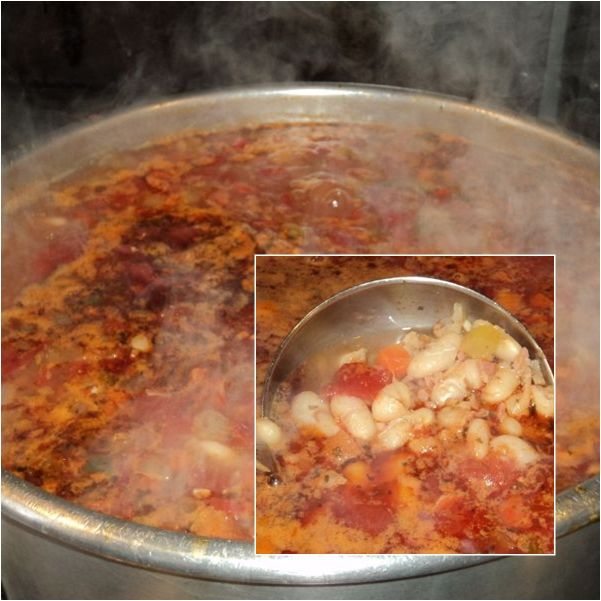
A few days ago I awoke to find that I had a cold. It was my own fault, I thought, for burning the candle at both ends and leaving myself susceptible. Intuitively I craved comfort food; soup, maybe some bread. I had a few vegetables in the refrigerator, but not nearly enough to make a hearty soup, and surly I was in no condition to go to the store. I figured there must be a few late-season vegetables in my small weed-infested garden. So I went out and rummaged. I hadn’t been back there for a while and was surprised to find more than enough vegetables. They seemed to be clinging to their withered plants in an attempt to ward of impending autumn. There were a surprising number of perfectly ripe tomatoes, and also some beans, a few ears of corn, a type of hard squash that I don’t remember planting, and even a couple small heads of cabbage. And this is how I happened to find myself wearing a bathrobe in my backyard with a runny nose and coffee cup in one hand and scissors in the other on a chilly morning in late September.

I had boiled a chicken the night prior but didn’t want meat in the soup, just the flavor, so I removed the chicken from its now cold and shimmering broth and put it back in the fridge for another time. I peeled the surface fat from the broth and put it on a flame to simmer and reduce a little, to intensify. While the broth began to move and swirl as it warmed I mixed a batch of sourdough. When I lifted the lid to the sourdough starter it made its usual “puff” sound, and it’s distinctively sour and yeasty smell filled the air. I could smell it even through my nasal congestion, or maybe it was psychosomatic and I just thought I smelled it. Either way, I enjoyed its aroma as I always do. After adding some starter and a few other ingredients to the mixer I fed the remaining starter and imagined the microscopic yeast gobbling up the fresh food…bread starter, the original virtual pet I thought, and one that I’ve nurtured and fed for more than 9 years. The late Parisian baker, Lionel Poilane, claimed that the starter from which all of his breads were leavened was more than a hundred years old, that it began with his grandfather.

Every culture has a name for naturally leavened breads; we call them sourdough because of the often sour flavor the fermenting grain produces. The French refer to them as pain au levain (risen bread, or bread with yeast); the French word for yeast is levure. The English word, leaven, and the French, levain, share the same origins. They stem from the Latin, lavare, meaning to raise. In fact, the Biblical lands of the Eastern Mediterranean, which is the birthplace of bread, share a related title for the land itself: the Levant, making reference to the sun rising in the east.

As the bread mixed I glanced at the starter, and scrawled on its container is 7/99, as in July 1999. To me the summer of 1999 seems like light years away yet at the same time just yesterday. Like a gold miner traveling north or a spiritual pilgrim going east, I’ve carried this starter with me through 3 residences in the last 9 years. Sometimes I’ve left it dormant in the refrigerator for months because I couldn’t muster the effort it took to care for it, much in the same way–I can now see in retrospect–that I too have retreated at times to dormancy for relief and rest. There were times when I left it the starter for so long in the refrigerator–months on end–that I didn’t think that I’d be able to resurrect it, but I have. There were also times in past years that I wondered if I myself would survive personal tribulations, but I have. After the dough had mixed I placed it in a brotformen (German bread rising basket), then went to task at cutting the vegetables.

I enjoy the paradox of both soup and bread: they’re made with the most basic ingredients but at the same time can also be two of the most nourishing foods; they can be the simplest foods to make, but also some of the most complex. Both soup and bread are the type of food that can be made simply at home by the layperson, but at the same time culinary institutions devote entire courses to their subject. They are, in fact, two titles in the French hierarchal culinary system that are very specific. A baker for example, is not just a baker, they’re a boulanger (literally, ball maker), referring to the traditional shape of pain au levain, the precursor to the baguette. And a soup maker is a potager, or someone who makes thick soups or one-pot meals.

When I finished dicing the vegetables I heated a little olive oil in a pot and added them to it, first some onions, carrot, peppers, and cabbage, then, after they sweat out some of their flavor, I added the remainder, along with garlic, a little crushed hot pepper, and a few herbs. My two small dogs laid at my feet waiting for scraps to fall.

Everyone knows, I’m sure, that the denial of cold symptoms can only last so long. For me, they come in waves. And as I was sautéing the vegetables I suddenly felt the need to lay down. So that’s just what I did. After shutting off the burners for both the chicken broth and the sautéing vegetables I laid on the couch covered in two blankets. My dogs joined me. I thought I would have taken only a twenty minute nap but four hours elapsed. I felt refreshed, albeit slightly dizzy (dizzier then usual, I may add). I also felt really hungry, which I thought was a good sign.

Entering the kitchen I saw the bread was fully risen, so-much-so that if I slumbered any longer it may have over-risen and fallen. I turned on the oven and the burner. When the vegetables heated I added chicken broth and brought it to a boil then lowered it to a simmer; it smelled great. After the oven was heated I turned the dough out onto a baker’s peel. Using a razorblade I scored an X into the top of the bread, for both ascetics and practicality; it’s also bread-making symbolism that dates back to the earliest Christians. And as I did this it released some of the restraint of its outer dried surface, immediately allowing the bread to expand further. This never ceases to amaze me.

After baking the bread and simmering the soup I ate, and it was good. I buttered the bread while it was still warm. It had a sour and slightly nutty flavor that only sourdough can. I dipped small pieces of crust into the soup, and tossed them to my two pugs because they stared at me so intently it looked as if their bulging eyes would pop right out. As I ate the soup I tried to remember how it felt to plant the vegetables earlier that year, the feeling of the soil in my fingers; I thought of how the little plot of earth on which I live nourished them and how they now nourish me. I also thought of the origin of the English word soup, which comes from the Old English sup (same origins as the word supper), referring to a thin soup poured over a stale piece of bread and enriching both foods, making it a full meal, or at least one that could make you full. To eat soup is to sup; to sup is to eat. A symbiotic relationship, this soup and bread, I thought. I felt full, both physically and metaphorically, and with that thought in mind I laid back on the couch and pulled the blankets up tight.

Potage de Legumes
(Hearty Vegetable Soup)

Dice whatever vegetables you have on hand. Heat a small amount of olive oil or butter in a pot. When the fat is hot add the hard or sweet vegetables first (onions, celery, carrots, turnip, cabbage, fennel, etc.). Cook the vegetables for a few minutes to release their flavor, then add a chopped clove of garlic with a few herbs. Then add the softer vegetables (zucchini, tomatoes, corn, broccoli, potatoes, etc.). Stir in enough broth to cover the vegetables by a couple inches. Bring the soup to a boil, then lower it to a simmer. Season with salt and pepper. Simmer the soup for about 1/2 hour, or until all the vegetables are very soft.

Pain Au Levain
(Sourdough Bread)

For The Starter:

Boil an organic potato in filtered water, allow to cool to room temperature. Remove the potato and save for another use. Combine 1/2 cup potato water in a glass bowl with 1/2 cup organic rye flour. Cover the bowl with a towel or cheese cloth and allow it to rest at room temperature for 24 hours. Stir in another 1/2 cup water and 1/2 cup rye flour. Repeat this process for a few days, discarding some of the batter as necessary. When small bubbles or froth begin to appear, feed the starter twice a day for a week. At this point it should be fully active and strong enough to leaven a loaf of bread.

For The Bread:

Combine these ingredients in the bowl of an upright mixer fitted with a dough hook: 2 cups fully active starter, 1 1/2 cups water, 2 tablespoons olive oil, 2 cups whole wheat flour, 3 1/2 cups bread flour, 1 tablespoon kosher salt. Run the mixer on low until a ball of dough forms. The dough should be sticky, but not wet. If it is too wet add more flour, if it is too dry add a little water. Run the mixer on medium speed for about 6 minutes, then remove the dough to a counter and knead it by hand for a few minutes longer. Divide the dough into two pieces and place them into a well-floured baskets or oiled bread pans. Leave the dough to rest until doubled in size (depending on the strength of your starter and the warm of your kitchen, this will take between 2 and 12 hours). Preheat an oven to 450F and bake the bread for about 45 minutes. Cool for 10 minutes before slicing.
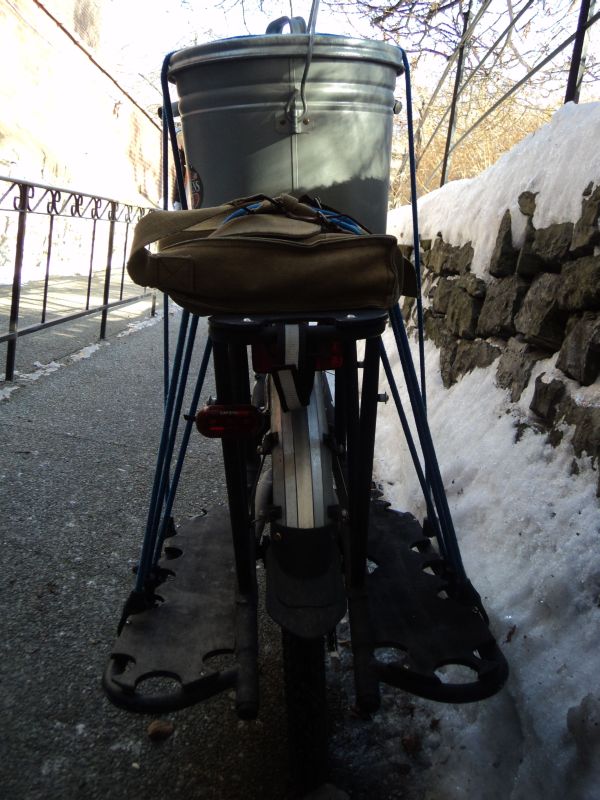
Things That Can Be Carried On A Bike (#270)

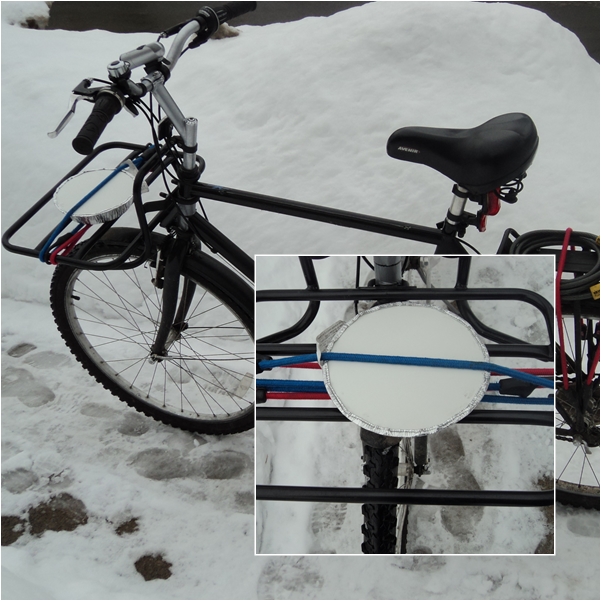
3 partially used tapered candles (2ft/ 61cm each). A canvas bag containing, among other things, a semi-functioning netbook, an e-book reader containing approximately 157 books, an actual book, a day planner, and various writing implements. A cable (and lock) measuring 6 ft (1.8m) in length.

>Things That Can Be Carried On A Bike (#270)

>

3 partially used tapered candles (2ft/ 61cm each). A canvas bag containing, among other things, a semi-functioning netbook, an e-book reader containing approximately 157 books, an actual book, a day planner, and various writing implements. A cable (and lock) measuring 6 ft (1.8m) in length.

Five Quotes from Thich Nhat Hanh

Photo found here.

To visit the website of Plum Village, click here; to read more about Thich Nhat Hanh, click here.

“Every thought you produce, anything you say, any action you do, it bears your signature.”
“People usually consider walking on water or in thin air a miracle. But I think the real miracle is not to walk either on water or in thin air, but to walk on earth. Every day we are engaged in a miracle which we don’t even recognize: a blue sky, white clouds, green leaves, the black, curious eyes of a child — our own two eyes. All is a miracle.” 
“Waking up this morning, I smile. Twenty-four brand new hours are before me. I vow to live fully in each moment and to look at all beings with eyes of compassion.”  

“Many people are alive but don’t touch the miracle of being alive.”


“Life is available only in the present moment.” 
.

>Five Quotes from Thich Nhat Hanh

>

Photo found here.

To visit the website of Plum Village, click here; to read more about Thich Nhat Hanh, click here.

“Every thought you produce, anything you say, any action you do, it bears your signature.”
“People usually consider walking on water or in thin air a miracle. But I think the real miracle is not to walk either on water or in thin air, but to walk on earth. Every day we are engaged in a miracle which we don’t even recognize: a blue sky, white clouds, green leaves, the black, curious eyes of a child — our own two eyes. All is a miracle.” 
“Waking up this morning, I smile. Twenty-four brand new hours are before me. I vow to live fully in each moment and to look at all beings with eyes of compassion.”  

“Many people are alive but don’t touch the miracle of being alive.”


“Life is available only in the present moment.” 
.

Pain Perdue et Haute Cuisine (un oxymoron ou non?)

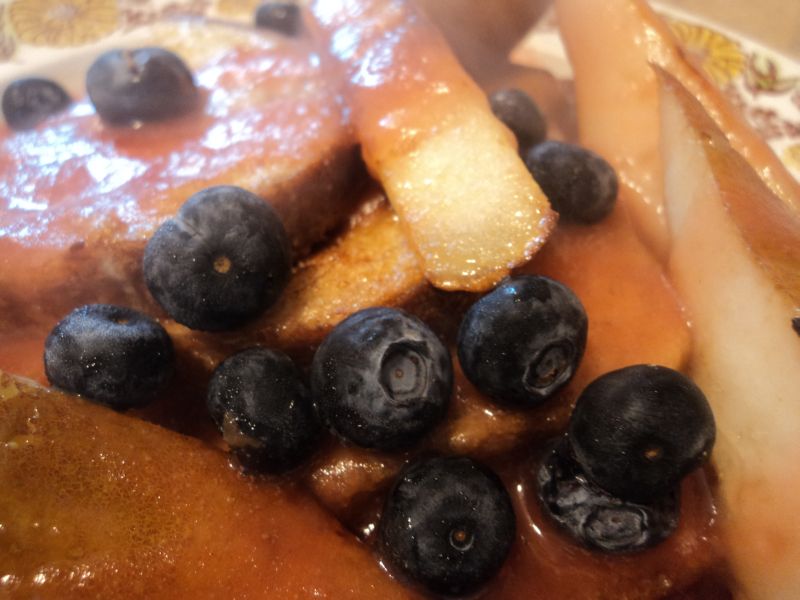
I’ve posted in the past that my son’s favorite breakfast (or lunch) is French toast (click here, here, or here), and this is just another variation. I, of course, used homemade whole wheat bread for this version, but I also made a sort of syrup/puree out of apple, nectarine, honey, and simple syrup. And while the bread cooked I caramelized fresh pear and at the last minute added blueberries to the pan for just a few seconds…the outcome was delicious (as confirmed by the smile on my son’s face as I handed him the heaping plate and the cleaned plate that he handed back 5 minutes later).

Anyhow, a bit of explanation of the title of the post. French Toast, as many may know, is called pain perdue (or perdu), which translates as lost bread in French Louisiana dialect and some other French speaking areas of the world. It makes reference to the bread being stale, or “lost;” something someone would cook if they were low on cash or being frugal (of which I am both). But as I cooked my son’s breakfast I couldn’t help but think that if I were serving this in a restaurant this would get top dollar…freshly made bread (anything but lost) topped with fresh fruit and a fruit puree; it should be called pain trouvé, or “found bread” in my opinion. This, I thought, belongs more to Haute Cuisine (high cooking) than it does Cuisine Paysan (or peasant cooking).

Anyhow, sorry for the somewhat self-centered tangent (more of a stream of thought, really), here’s how to make it (and the variations are up to you…use whatever fruit or bread that you have on hand or really like).

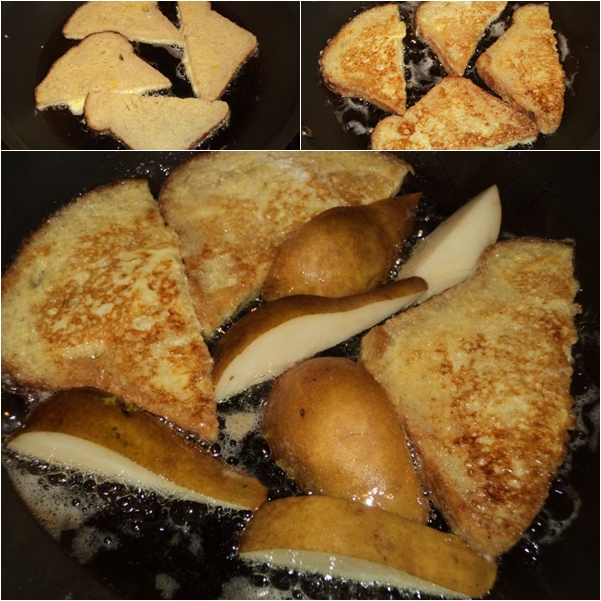
Make a basic custard by mixing together a few eggs and a bit of milk; lay a few slices of bread in a bowl and pour the egg mixture over them. While the bread soaks, make a fruit syrup/puree. Do this by first combining a small amount of sugar, water, and honey in a small pan and bringing it to a simmer (I also added a pinch of cinnamon); then add whatever sliced or diced fruit that you like. Cook the fruit for a few minutes, transfer it to a blender; then after pureeing it, transfer it back to the pan. Simmer the puree while you cook the bread; it will become thick and syrupy (but at the same time be careful not to burn it).

While the syrup cooks, cook the bread that has been soaking in the custard. Turn it a couple of times so it browns without burning and cooks the eggs that have soaked into the center of the bread. And as the bread cooks add whatever fruit you like to the pan and caramelize it to bring out it’s natural sweetness. If you are using delicate fruit, such as berries, give them just a few seconds in the hot fat to bring out their flavor and break their skins a bit.

Arrange everything on a plate (or plates) and pour the syrup over. The best part is the next…seeing the look on the person’s face as they eat it. Yum!

>Pain Perdue et Haute Cuisine (un oxymoron ou non?)

>

I’ve posted in the past that my son’s favorite breakfast (or lunch) is French toast (click here, here, or here), and this is just another variation. I, of course, used homemade whole wheat bread for this version, but I also made a sort of syrup/puree out of apple, nectarine, honey, and simple syrup. And while the bread cooked I caramelized fresh pear and at the last minute added blueberries to the pan for just a few seconds…the outcome was delicious (as confirmed by the smile on my son’s face as I handed him the heaping plate and the cleaned plate that he handed back 5 minutes later).

Anyhow, a bit of explanation of the title of the post. French Toast, as many may know, is called pain perdue (or perdu), which translates as lost bread in French Louisiana dialect and some other French speaking areas of the world. It makes reference to the bread being stale, or “lost;” something someone would cook if they were low on cash or being frugal (of which I am both). But as I cooked my son’s breakfast I couldn’t help but think that if I were serving this in a restaurant this would get top dollar…freshly made bread (anything but lost) topped with fresh fruit and a fruit puree; it should be called pain trouvé, or “found bread” in my opinion. This, I thought, belongs more to Haute Cuisine (high cooking) than it does Cuisine Paysan (or peasant cooking).

Anyhow, sorry for the somewhat self-centered tangent (more of a stream of thought, really), here’s how to make it (and the variations are up to you…use whatever fruit or bread that you have on hand or really like).

Make a basic custard by mixing together a few eggs and a bit of milk; lay a few slices of bread in a bowl and pour the egg mixture over them. While the bread soaks, make a fruit syrup/puree. Do this by first combining a small amount of sugar, water, and honey in a small pan and bringing it to a simmer (I also added a pinch of cinnamon); then add whatever sliced or diced fruit that you like. Cook the fruit for a few minutes, transfer it to a blender; then after pureeing it, transfer it back to the pan. Simmer the puree while you cook the bread; it will become thick and syrupy (but at the same time be careful not to burn it).

While the syrup cooks, cook the bread that has been soaking in the custard. Turn it a couple of times so it browns without burning and cooks the eggs that have soaked into the center of the bread. And as the bread cooks add whatever fruit you like to the pan and caramelize it to bring out it’s natural sweetness. If you are using delicate fruit, such as berries, give them just a few seconds in the hot fat to bring out their flavor and break their skins a bit.

Arrange everything on a plate (or plates) and pour the syrup over. The best part is the next…seeing the look on the person’s face as they eat it. Yum!

Restaurant on a Bike

Is it just me or is this really cool? I can’t remember where I found this image but I just came across it on my hard drive and thought I’d pass it along. Just another example of the usefulness of bikes. In the past I’ve posted on the taco bike, but that looks like a full restaurant on a bike to me (is that a deep fryer?). Why, I wonder, don’t we see this type of thing in the good ol’ U.S. of A…probably because the health department would shut it down. I may be naive, but that to me seems like my dream job (but I would rather have a grill and a skillet than a fryer…minor details).

>Restaurant on a Bike

>

Is it just me or is this really cool? I can’t remember where I found this image but I just came across it on my hard drive and thought I’d pass it along. Just another example of the usefulness of bikes. In the past I’ve posted on the taco bike, but that looks like a full restaurant on a bike to me (is that a deep fryer?). Why, I wonder, don’t we see this type of thing in the good ol’ U.S. of A…probably because the health department would shut it down. I may be naive, but that to me seems like my dream job (but I would rather have a grill and a skillet than a fryer…minor details).

Virtual Problems

Firstly let me just say that I enjoy writing this blog…mostly it is (as I had originally intended it to be) a sort of online journal on living simply in the city and simplifying my life. Things don’t seem to be getting much simpler–indeed some days, many days, it is the opposite–but I still enjoy doing it. And judging by the amount of daily hits, I believe others enjoy it as well. I like to post every day or at least every-other-day…it has become a sort of routine for me. So you can imagine my surprise 3 days ago when I went to log on and was told that I had either an incorrect password or user name. Thinking I had miss-typed I tried it again, then a few more times, but to no avail. I had not changed anything and had used the same password and user name since my very first post. After a few rounds with the blogger help page I was told that this account was affiliated with an email I had used when I first toyed with blogging and started one but never got it off the ground…in short, that blog and email have not existed in almost 4 years. Huh? To make the story shorter, I was eventually able to reestablish a (new) password and user name and access this blog.  So the question I am wondering is was I hacked or was this some sort of Blogger.com error…an ancient blog floating in cyberspace gone awry? Whatever the reason, after I was able to access this blog, as a precautionary measure I’ve started a mirror blog at WordPress. This is still my main blog from which I will post, but once a week or so I will import it there (click here to see it). It has all of the posts but not the links (eventually it will). Periodically I do take a few days off–and very rarely even a week–but if you notice that I havn’t been posting you may want to check in the WordPress blog…the way I see it, if I was locked out before and for no reason on my part it may happen again. And if it does I’ll have a back up.  As always, thanks for visiting and commenting…for without readers there is, in my opinion, no reason to blog. Peace.

>Virtual Problems

>

Firstly let me just say that I enjoy writing this blog…mostly it is (as I had originally intended it to be) a sort of online journal on living simply in the city and simplifying my life. Things don’t seem to be getting much simpler–indeed some days, many days, it is the opposite–but I still enjoy doing it. And judging by the amount of daily hits, I believe others enjoy it as well. I like to post every day or at least every-other-day…it has become a sort of routine for me. So you can imagine my surprise 3 days ago when I went to log on and was told that I had either an incorrect password or user name. Thinking I had miss-typed I tried it again, then a few more times, but to no avail. I had not changed anything and had used the same password and user name since my very first post. After a few rounds with the blogger help page I was told that this account was affiliated with an email I had used when I first toyed with blogging and started one but never got it off the ground…in short, that blog and email have not existed in almost 4 years. Huh? To make the story shorter, I was eventually able to reestablish a (new) password and user name and access this blog.  So the question I am wondering is was I hacked or was this some sort of Blogger.com error…an ancient blog floating in cyberspace gone awry? Whatever the reason, after I was able to access this blog, as a precautionary measure I’ve started a mirror blog at WordPress. This is still my main blog from which I will post, but once a week or so I will import it there (click here to see it). It has all of the posts but not the links (eventually it will). Periodically I do take a few days off–and very rarely even a week–but if you notice that I havn’t been posting you may want to check in the WordPress blog…the way I see it, if I was locked out before and for no reason on my part it may happen again. And if it does I’ll have a back up.  As always, thanks for visiting and commenting…for without readers there is, in my opinion, no reason to blog. Peace.