>I came across this and a few other short videos on Treehugger. It’s a 4-minute clip of a Chilean bicyclist doing a downhill race in the city through all sorts of perilous circumstances…and he has a camera mounted on his helmet. As Treehugger suggests, watch it in full screen mode…it is pretty incredible. Watching it (to me) was like a cross between riding on a roller coaster and watching a video game. There were points when I actually said out loud…whoooaa! It is really entertaining.
VCA 2010 RACE RUN from changoman on Vimeo.Things That Can Be Carried On A Bike (#282)


>Things That Can Be Carried On A Bike (#282)
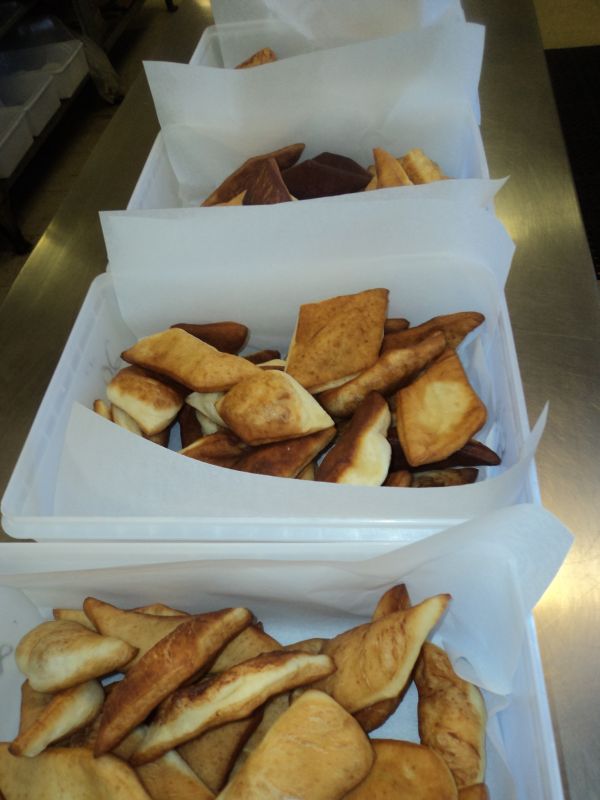
Fastnacht Kuecheles

This is a recipe I received from one of my sisters, who received it from our mother, who learned it from our grandmother, who undoubtedly learned it from her mother, and so on. I can still vividly recall the image of my mother’s dough rising in a ceramic bowl covered in a towel on the radiator in our kitchen, and the yeasty aroma of rising sweet dough permeating the air (they are also tossed in powdered sugar just before you eat them…as these were later). It is a type of fried doughnut very similar to the French Beignet (but most nationalities have a version of this, I assume), and it’s traditionally eaten on this day each year, fastnacht (fast night), or the night before the beginning of Lent. Iy’s a day when Christians are supposed to use of all the fats and other rich foods in the house to prepare themselves to live lean and turn inward for the next 40 days. This is also why in some areas of the world this day is called Mardi Gras (Fat Tuesday) or Carnival (loosely, farewell to flesh); in English it’s of course a little more reserved (some may say boring) as Shrove Tuesday. These are simple to make and are a treat any time of the year, but not if you are trying to live lean, literally or metaphorically. To see previous posts and an article I wrote (with additional recipes), click here, here, or here.
Fastnacht Kuecheles
Makes about 3 dozen
1 cup water (room temperature)
1 cup milk (room temperature)
1/2 cup granulated sugar
4 tablespoons yeast
6-7 cups all-purpose flour, divided
3 large eggs
1/2 cup unsalted butter, melted
1 teaspoon salt
powdered sugar
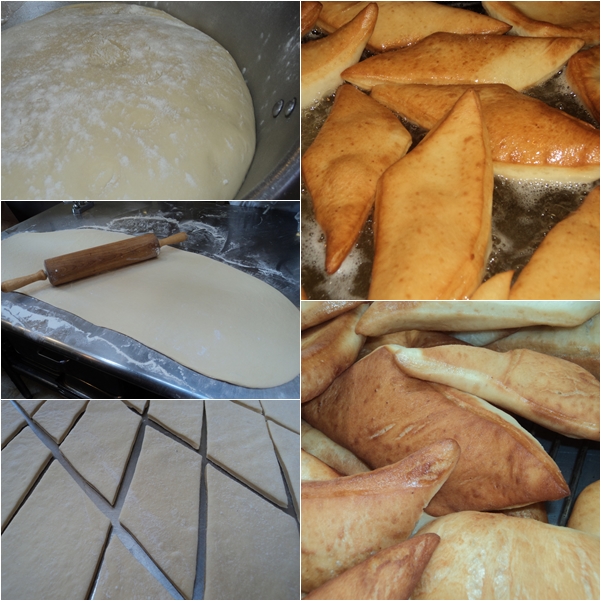
Combine the water, milk, sugar, yeast, and two cups of flour in a large bowl. Allow to rest for 1 hour, or until the yeast is fully active. Transfer to an upright mixing bowl with a dough hook. Add the eggs, melted butter, salt, and 4 cups of flour. Run the mixer on low for 1 minute (if the dough seems too sticky add the remaining cup flour) then turn to medium and knead for 5 minutes. Transfer to a lightly oiled bowl, cover and let rest at room temperature for about an hour, or until double in size. Transfer the dough to a floured work surface and cut into three pieces. Shape into balls, cover, and let rest 20 minutes. Roll into large circles about 1/4 inch thick, then cut the dough into diamonds 2-4 inches wide. Cover the diamonds with a cloth and let rest 10 minutes. Preheat a couple inches of vegetable oil to 350F in a heavy skillet. Carefully fry the fastnachts in batches, cooking them for a couple minutes on each side until they are puffed and golden-brown; drain on absorbent paper. Allow them to cool for a few minutes, then toss a few at a time in a paper bag with confectionery sugar.

>Fastnacht Kuecheles
>
This is a recipe I received from one of my sisters, who received it from our mother, who learned it from our grandmother, who undoubtedly learned it from her mother, and so on. I can still vividly recall the image of my mother’s dough rising in a ceramic bowl covered in a towel on the radiator in our kitchen, and the yeasty aroma of rising sweet dough permeating the air (they are also tossed in powdered sugar just before you eat them…as these were later). It is a type of fried doughnut very similar to the French Beignet (but most nationalities have a version of this, I assume), and it’s traditionally eaten on this day each year, fastnacht (fast night), or the night before the beginning of Lent. Iy’s a day when Christians are supposed to use of all the fats and other rich foods in the house to prepare themselves to live lean and turn inward for the next 40 days. This is also why in some areas of the world this day is called Mardi Gras (Fat Tuesday) or Carnival (loosely, farewell to flesh); in English it’s of course a little more reserved (some may say boring) as Shrove Tuesday. These are simple to make and are a treat any time of the year, but not if you are trying to live lean, literally or metaphorically. To see previous posts and an article I wrote (with additional recipes), click here, here, or here.
Fastnacht Kuecheles
Makes about 3 dozen
1 cup water (room temperature)
1 cup milk (room temperature)
1/2 cup granulated sugar
4 tablespoons yeast
6-7 cups all-purpose flour, divided
3 large eggs
1/2 cup unsalted butter, melted
1 teaspoon salt
powdered sugar
Combine the water, milk, sugar, yeast, and two cups of flour in a large bowl. Allow to rest for 1 hour, or until the yeast is fully active. Transfer to an upright mixing bowl with a dough hook. Add the eggs, melted butter, salt, and 4 cups of flour. Run the mixer on low for 1 minute (if the dough seems too sticky add the remaining cup flour) then turn to medium and knead for 5 minutes. Transfer to a lightly oiled bowl, cover and let rest at room temperature for about an hour, or until double in size. Transfer the dough to a floured work surface and cut into three pieces. Shape into balls, cover, and let rest 20 minutes. Roll into large circles about 1/4 inch thick, then cut the dough into diamonds 2-4 inches wide. Cover the diamonds with a cloth and let rest 10 minutes. Preheat a couple inches of vegetable oil to 350F in a heavy skillet. Carefully fry the fastnachts in batches, cooking them for a couple minutes on each side until they are puffed and golden-brown; drain on absorbent paper. Allow them to cool for a few minutes, then toss a few at a time in a paper bag with confectionery sugar.
Kim-Chi (sort of)
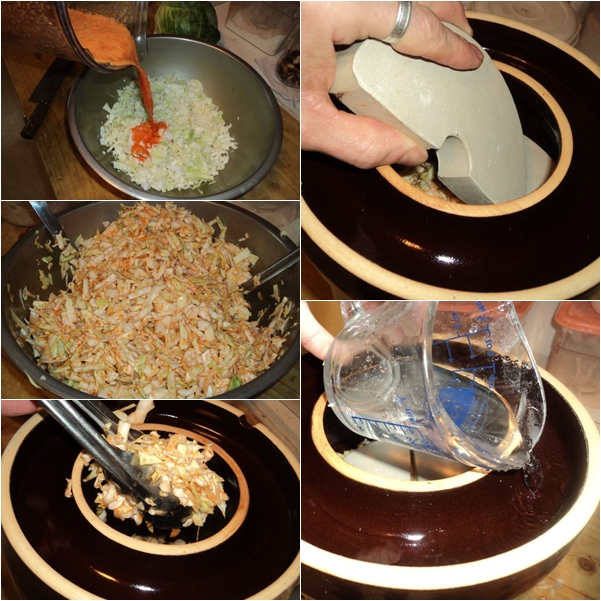
I have been fascinated with naturally fermented foods for years…not only are they extremely good for you, they basically make themselves…you simply provide the right conditions. While some of these foods may be an acquired taste, once you have them they are like a drug…truly addicting. Anyhow, I’ve been going back-and-forth whether or not I was going to order a crock from Amazon that was made specifically for fermenting vegetables (click here to see it), but very recently I discovered they are available in my home city…and for nearly half the price (click here to see it). Very exciting. For years I’ve made fermented vegetables in plastic buckets…and sometimes air will get in and ruin the ferment. What’s unique about these crocks is not only do they come fitted with a stone that fits perfectly as a weight, they also have a water “air lock” which lets gasses out as it ferments but does not let anything in (see below).
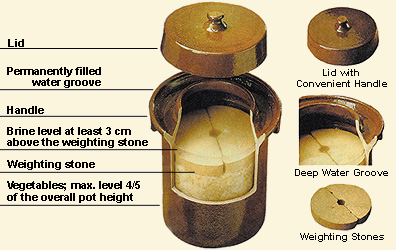
Photo found here.
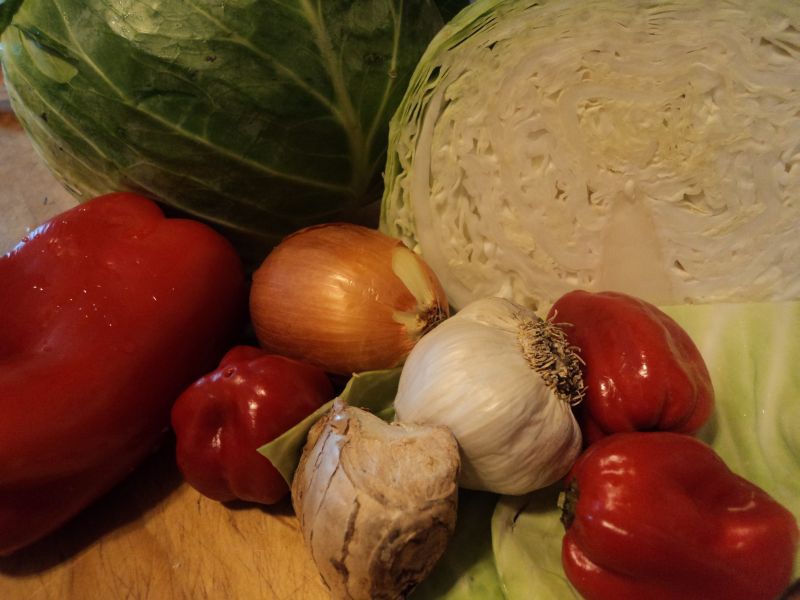
Anyhow, my first order of business, after washing the new crock, was to begin a ferment. The easiest and probably the most universal vegetable ferment is cabbage, as in sauerkraut (sour cabbage), but one of my favorite variations is the spicy Korean version called Kim-Chi. And the reason I titled this post a “sort of” kim-chi is because I did not have the traditional Napa cabbage; I used ordinary green cabbage instead. I’ve made it using this cabbage before and the results are still outstanding. Another thing I did a little differently was make a puree/brine out of salt water, habanero chilies, ginger, and garlic, which I added to the cabbage (yow! It’s already spicy…but man is it good). Now the waiting is the hardest part. Here it is in pictures; a recipe follows. If you’d like to learn more about fermented foods–their health benefits and how to make them (and with additional recipes)–click here or here. If you’d like to see more of my adventures (experiments) in fermentation, click here. And if you are looking for a good book on the subject, I recommend this one.
Kim Chi
(Korean-Style Sauerkraut)
1 head Napa cabbage, cut into two-inch pieces
1 small daikon, grated
2 tablespoons kosher salt
2 cloves garlic, minced
1 small piece ginger, minced
1 small onion, minced
2 tablespoons chili paste
1 tablespoon sugar
Mix all of the ingredients together in a large bowl. Transfer to a container that is wide enough to fit a few small plates inside it. Press the cabbage down and weight it with plates. Cover the container and leave at room temperature. After a day it should release enough liquid that it is submerged, if not, add a little salted water. After about 2 days small bubbles will appear, after about a week or so it will smell and taste distinctively sour. Taste it as often as you like and when the flavor is to your liking transfer the container to the refrigerator to slow its fermentation.


>Kim-Chi (sort of)
>
I have been fascinated with naturally fermented foods for years…not only are they extremely good for you, they basically make themselves…you simply provide the right conditions. While some of these foods may be an acquired taste, once you have them they are like a drug…truly addicting. Anyhow, I’ve been going back-and-forth whether or not I was going to order a crock from Amazon that was made specifically for fermenting vegetables (click here to see it), but very recently I discovered they are available in my home city…and for nearly half the price (click here to see it). Very exciting. For years I’ve made fermented vegetables in plastic buckets…and sometimes air will get in and ruin the ferment. What’s unique about these crocks is not only do they come fitted with a stone that fits perfectly as a weight, they also have a water “air lock” which lets gasses out as it ferments but does not let anything in (see below).
Photo found here.
Anyhow, my first order of business, after washing the new crock, was to begin a ferment. The easiest and probably the most universal vegetable ferment is cabbage, as in sauerkraut (sour cabbage), but one of my favorite variations is the spicy Korean version called Kim-Chi. And the reason I titled this post a “sort of” kim-chi is because I did not have the traditional Napa cabbage; I used ordinary green cabbage instead. I’ve made it using this cabbage before and the results are still outstanding. Another thing I did a little differently was make a puree/brine out of salt water, habanero chilies, ginger, and garlic, which I added to the cabbage (yow! It’s already spicy…but man is it good). Now the waiting is the hardest part. Here it is in pictures; a recipe follows. If you’d like to learn more about fermented foods–their health benefits and how to make them (and with additional recipes)–click here or here. If you’d like to see more of my adventures (experiments) in fermentation, click here. And if you are looking for a good book on the subject, I recommend this one.
Kim Chi
(Korean-Style Sauerkraut)
1 head Napa cabbage, cut into two-inch pieces
1 small daikon, grated
2 tablespoons kosher salt
2 cloves garlic, minced
1 small piece ginger, minced
1 small onion, minced
2 tablespoons chili paste
1 tablespoon sugar
Mix all of the ingredients together in a large bowl. Transfer to a container that is wide enough to fit a few small plates inside it. Press the cabbage down and weight it with plates. Cover the container and leave at room temperature. After a day it should release enough liquid that it is submerged, if not, add a little salted water. After about 2 days small bubbles will appear, after about a week or so it will smell and taste distinctively sour. Taste it as often as you like and when the flavor is to your liking transfer the container to the refrigerator to slow its fermentation.
Curried Vegetable and Lamb Ragout (in pictures)

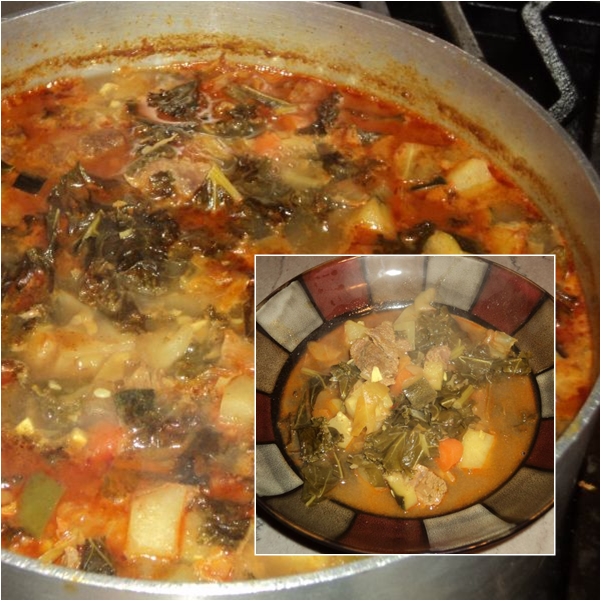
This is a very simple yet hearty and flavorful ragout. The method for a dish like this is about as simple as it gets: Saute or sweat whatever ingredients you have at hand or want to eat–meat, fish, poultry, or just vegetables–then add seasonings, liquid (broth and sometimes wine) and simmer for a while. Having made a recent trip to Penzy’s spices (and spending a tad too much money there), and lamb being my preferred red meat, I made this stew. I love to cook this type of food at home–one dish meals that are self contained and easy to clean up–to see other versions with recipes and pictures click here, here, here, or here.


>Curried Vegetable and Lamb Ragout (in pictures)
>
This is a very simple yet hearty and flavorful ragout. The method for a dish like this is about as simple as it gets: Saute or sweat whatever ingredients you have at hand or want to eat–meat, fish, poultry, or just vegetables–then add seasonings, liquid (broth and sometimes wine) and simmer for a while. Having made a recent trip to Penzy’s spices (and spending a tad too much money there), and lamb being my preferred red meat, I made this stew. I love to cook this type of food at home–one dish meals that are self contained and easy to clean up–to see other versions with recipes and pictures click here, here, here, or here.
(more) Fortune Cookie Philosophy

I believe this to be true for everyone (if you allow yourself)…but sometimes I need a reminder. To read more fortune cookie philosophies, click here.

>(more) Fortune Cookie Philosophy
>
I believe this to be true for everyone (if you allow yourself)…but sometimes I need a reminder. To read more fortune cookie philosophies, click here.
Things That Can Be Carried On A Bike (#281)…and a few comments

Things that were carried (and pulled) on this particular ride:
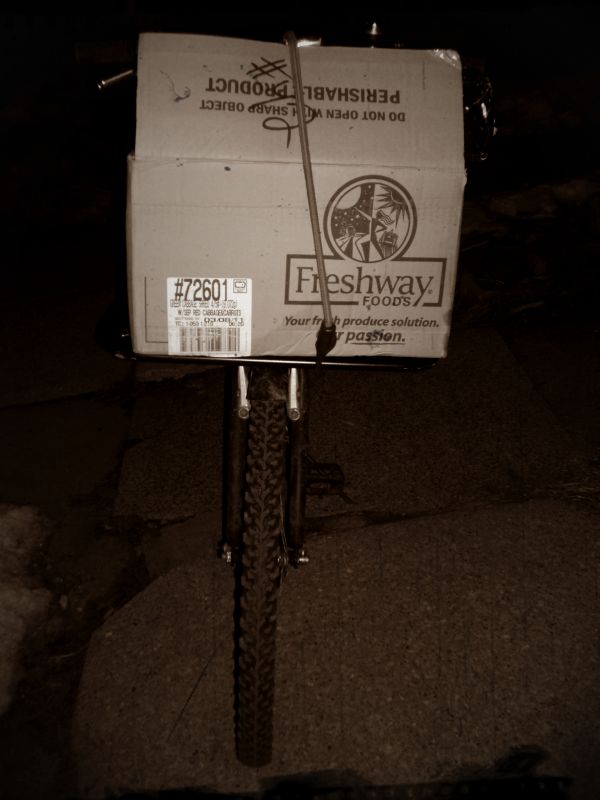
$121.47 in groceries and sundries, an 8lb. bag of dog food, 3L of red wine, and a gym bag full of wet clothes.
A few comments:
As stated over and over again (and over again) on this blog…I am not car-free, just car-lite, sometimes lighter than others. And it seems that this past winter has really been crunching the numbers with my riding ratio…the frigid cold and snowy winter has put somewhat of a damper on my riding, but not entirely of course. If I had to pick a number I would say that I still managed to ride or walk at least 75% of my (short) trips this past winter; opposed to something probably like 90% when the roads are clear. Anyhow, here’s an example of how a person can spend a day car-free and still accomplish a lot.
In the morning I rode my winter bike (pictured above) the short commute to work. Then after work I rode home, making a slight detour to stop at the bank. After stopping home I hitched the trailer to the bike and strapped an empty cardboard box to the front rack then rode the the health club for a brief steam and swim (I felt I only had to do half my regular workout when I was riding a 40lb bike and pulling a trailer into the wind…the bike ride was a workout in itself). On the way to the health club I stopped first to buy some wine (I get thirsty with all that pedaling and swimming), and then to another store to purchase dog food. After the swim I stopped at the grocery store on the way home and load up. When I brought the cart full of groceries out I looked at it’s fullness, then looked at the bike/trailer and really wondered how I was going to do this; the trailer and box on the front were literally overflowing (I had to push down on it like an over-stuffed suitcase to latch it)…but I did.
All-in-all, I probably only covered 10 miles throughout the day…but I did it using my own energy, and that makes me feel good, physically, psychologically, and emotionally. Even though I–like many cargo bikers–do this often, I still find it fun and amazing to do. Bikes, of course, are far from being simply a recreational toy, and they are much more than just a mode of transport (though they are really good at that)…bikes are also a utilitarian machine that carry not only you but also your cargo.

>Things That Can Be Carried On A Bike (#281)…and a few comments
>
Things that were carried (and pulled) on this particular ride:
$121.47 in groceries and sundries, an 8lb. bag of dog food, 3L of red wine, and a gym bag full of wet clothes.
A few comments:
As stated over and over again (and over again) on this blog…I am not car-free, just car-lite, sometimes lighter than others. And it seems that this past winter has really been crunching the numbers with my riding ratio…the frigid cold and snowy winter has put somewhat of a damper on my riding, but not entirely of course. If I had to pick a number I would say that I still managed to ride or walk at least 75% of my (short) trips this past winter; opposed to something probably like 90% when the roads are clear. Anyhow, here’s an example of how a person can spend a day car-free and still accomplish a lot.
In the morning I rode my winter bike (pictured above) the short commute to work. Then after work I rode home, making a slight detour to stop at the bank. After stopping home I hitched the trailer to the bike and strapped an empty cardboard box to the front rack then rode the the health club for a brief steam and swim (I felt I only had to do half my regular workout when I was riding a 40lb bike and pulling a trailer into the wind…the bike ride was a workout in itself). On the way to the health club I stopped first to buy some wine (I get thirsty with all that pedaling and swimming), and then to another store to purchase dog food. After the swim I stopped at the grocery store on the way home and load up. When I brought the cart full of groceries out I looked at it’s fullness, then looked at the bike/trailer and really wondered how I was going to do this; the trailer and box on the front were literally overflowing (I had to push down on it like an over-stuffed suitcase to latch it)…but I did.
All-in-all, I probably only covered 10 miles throughout the day…but I did it using my own energy, and that makes me feel good, physically, psychologically, and emotionally. Even though I–like many cargo bikers–do this often, I still find it fun and amazing to do. Bikes, of course, are far from being simply a recreational toy, and they are much more than just a mode of transport (though they are really good at that)…bikes are also a utilitarian machine that carry not only you but also your cargo.
Five Quotes from The Dalai Lama

Photo found here.
Our prime purpose in this life is to help others. And if you can’t help them, at least don’t hurt them.
There is no need for temples, no need for complicated philosophies. My brain and my heart are my temples; my philosophy is kindness.

>Five Quotes from The Dalai Lama
>
Photo found here.
Our prime purpose in this life is to help others. And if you can’t help them, at least don’t hurt them.
There is no need for temples, no need for complicated philosophies. My brain and my heart are my temples; my philosophy is kindness.
Things That Can Be Carried On A Bike (#280)
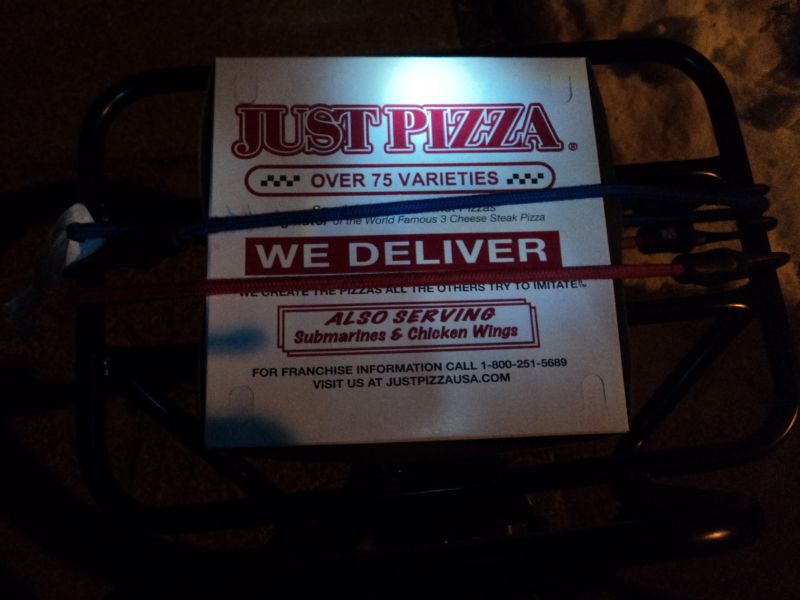
Dinner…picked up, not delivered.

>Things That Can Be Carried On A Bike (#280)
>
Dinner…picked up, not delivered.
Things That Can Be Carried On A Bike (#277-279)
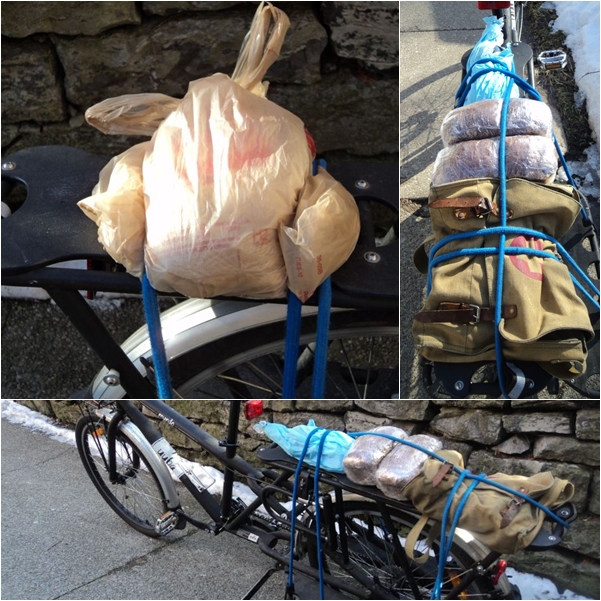
#277 (upper left)…A plastic bag containing two pounds of raw whole wheat bread dough.
#278 (Upper right)…A bottle of red wine, two loaves of freshly baked whole wheat bread, a canvas bag containing a few books, writing implements, and a Bike Rev trailer hitch.
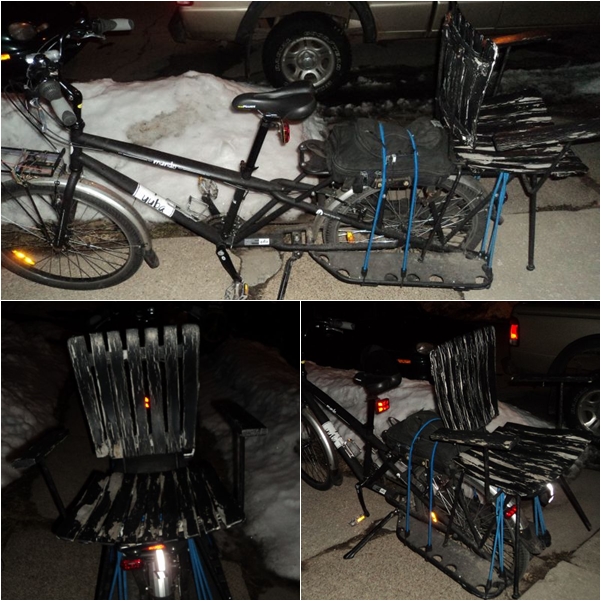
#279 (lower)…A gym bag full of wet clothes and a recently rescued chair.

>Things That Can Be Carried On A Bike (#277-279)
>
#277 (upper left)…A plastic bag containing two pounds of raw whole wheat bread dough.
#278 (Upper right)…A bottle of red wine, two loaves of freshly baked whole wheat bread, a canvas bag containing a few books, writing implements, and a Bike Rev trailer hitch.
#279 (lower)…A gym bag full of wet clothes and a recently rescued chair.
Employee Meal, 1 March 2011 (BBQ Chicken Thighs)
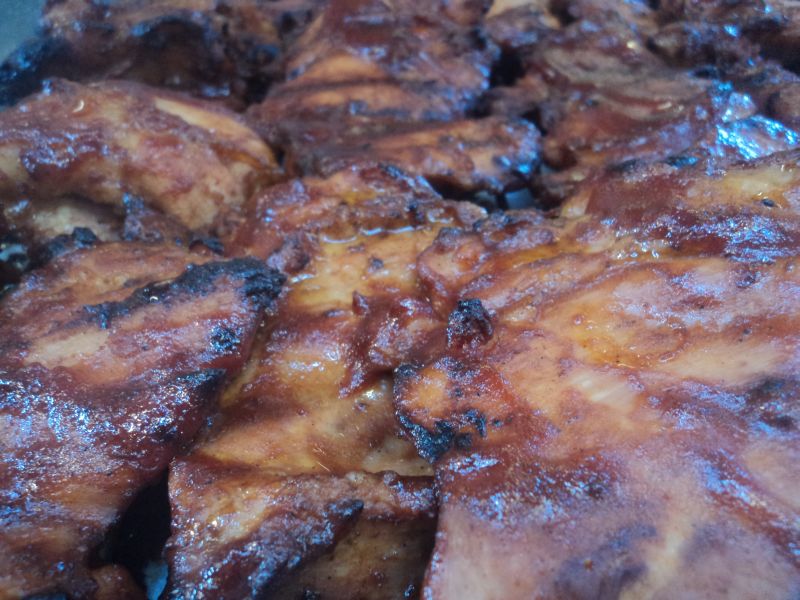
Espresso BBQ Sauce
Yield: 2 cups
2 tablespoons vegetable oil
1/2 cup minced onion
1 tablespoon minced garlic
1/2 cup brown sugar
2 tablespoons chili powder
1 tablespoon ground cumin
2 teaspoons ground cinnamon
1/2 teaspoon salt
1/2 teaspoon black pepper
1 cup espresso
1-1/2 cups ketchup
Heat the oil in a small heavy sauce pot. Add the onion and sauté until they just begin to caramelize. Stir in the garlic, sugar, chili powder, cumin, cinnamon, salt and black pepper, sauté for 2 or 3 minutes. Stir in the espresso and ketchup. Bring the sauce to a boil, then lower it to a simmer. Stir often with a wooden spoon. Cook the sauce, over low heat, for approximately 30 minutes, or until the sauce has reduced to approximately 2 cups. Store in a glass jar for up to 2 weeks.
Citrus-Serrano BBQ Glaze
Yield: 2 cups
1-1/2 cups orange juice
1-1/2 cups grapefruit juice
3/4 cup lime juice
1 cup ketchup
1 cup brown sugar
1/2 cup minced onion
1 tablespoon minced serrano chili
2 teaspoons minced garlic
1 teaspoon salt
Combine all of the ingredients in a small heavy sauce pot. Bring the glaze to a boil, skim the surface of any impurities, then lower the heat to a fast simmer. Continue to cook the sauce, while stirring with a wooden spoon frequently, for approximately 1 hour. The sauce should reduce by half, or to 2 cups, and have taken on a shiny syrupy consistency. Strain the glaze through a mesh colander and allow to cool somewhat before using. Store in a glass jar for up to 2 weeks.
Asian BBQ Sauce
Yield: 2 Cups
3/4 cup hoisin sauce
3/4 cup ketchup
1/4 cup soy sauce
2 tablespoons granulated sugar
2 tablespoons toasted sesame oil
1 teaspoon minced garlic
1 teaspoon minced ginger
1/2 teaspoon cayenne pepper
Combine all of the ingredients in a medium bowl and whisk until all of the ingredients are fully incorporated. Pour into a glass jar, or bowl, and let stand for at least 2 hours before use. Store in a glass jar for up to 2 weeks.

 Urban Simplicty