>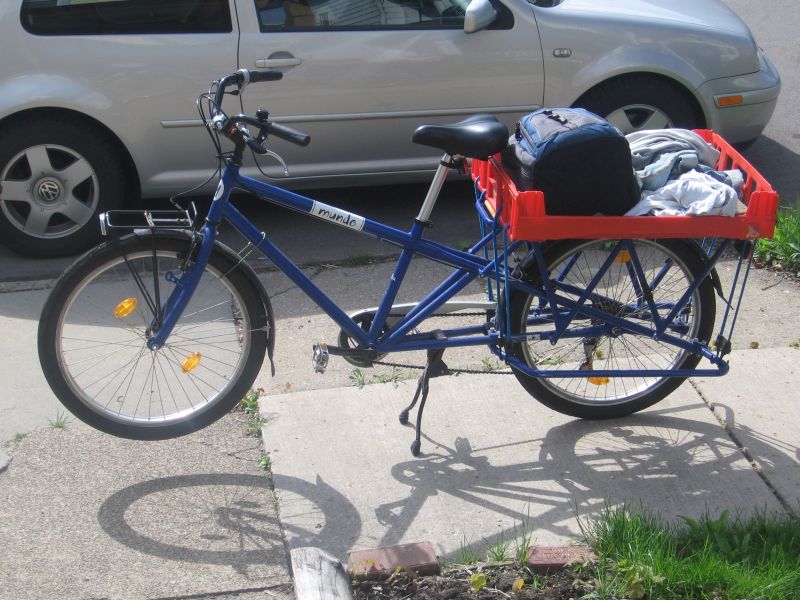 A large bread rack (to be used as my future “flatbed experiment”).
My son’s book bag with 40 lbs. of books.
His book report (laid flat as not to crease it).
A small shoulder bag with a few books.
A jean jacket.
A sweat shirt.
A U-lock and a cable lock.
Show Me The Green
 Well, I actually did it…I sold my old vehicle and am (temporarily) car-free. I took my old vehicle (it was two years older than my teen aged son) to the shop for its annual inspection and it didn’t pass. My mechanic (who I trust) told me of it’s ailments, and even politely questioned whether I wanted to put the money into it. No, I said, and asked him to take it down from the lift. I posted it on craigslist yesterday, received 15 inquiries, and sold it this evening. So for the first time in something like 20 years I am completely car-free. I have to admit that it will probably only be a temporary condition as I, unfortunately, still feel tethered (however loosely) to a motorized vehicle. At any rate, we’re heading into the warm months here in Buffalo, so it should be no problem…but it’s odd that I still have apprehensions…like being in a bad relationship for years and being apprehensive about leaving…you know it’s not good and that you should leave, but it’s what you’re used to. I blog (and talk) about bikes almost daily…this will really put it to the test…at least for a while.

>Show Me The Green
>Well, I actually did it…I sold my old vehicle and am (temporarily) car-free. I took my old vehicle (it was two years older than my teen aged son) to the shop for its annual inspection and it didn’t pass. My mechanic (who I trust) told me of it’s ailments, and even politely questioned whether I wanted to put the money into it. No, I said, and asked him to take it down from the lift. I posted it on craigslist yesterday, received 15 inquiries, and sold it this evening. So for the first time in something like 20 years I am completely car-free. I have to admit that it will probably only be a temporary condition as I, unfortunately, still feel tethered (however loosely) to a motorized vehicle. At any rate, we’re heading into the warm months here in Buffalo, so it should be no problem…but it’s odd that I still have apprehensions…like being in a bad relationship for years and being apprehensive about leaving…you know it’s not good and that you should leave, but it’s what you’re used to. I blog (and talk) about bikes almost daily…this will really put it to the test…at least for a while.
The Most Popular Vehicle
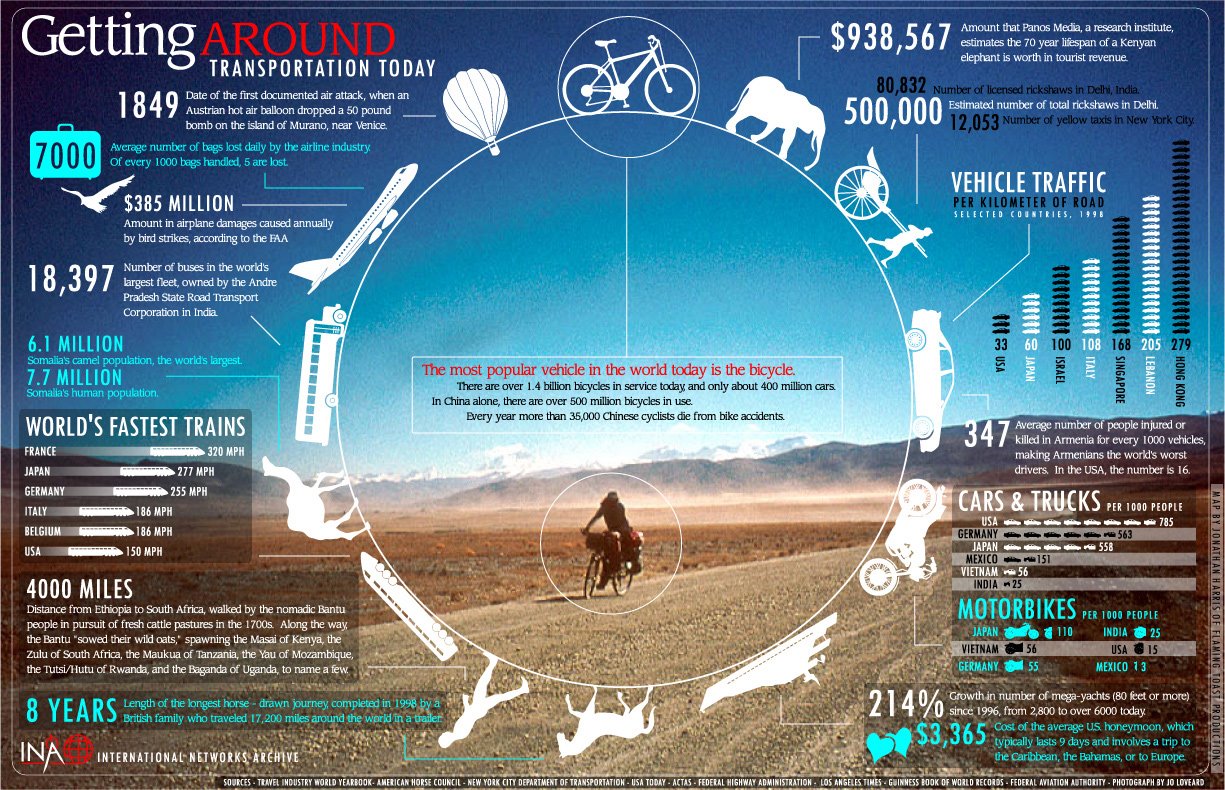
I came across this chart at Romanian Bike Culture Blog; I also found it posted here, at Treehugger. Click it on for a closer look. It’s rather interesting…especially that it states the bicycle is still the worlds most popular vehicle. Here’s an interesting link at EcoWorldly.com listing 17 reasons the bicycle is the worlds most popular vehicle.

>The Most Popular Vehicle
>I came across this chart at Romanian Bike Culture Blog; I also found it posted here, at Treehugger. Click it on for a closer look. It’s rather interesting…especially that it states the bicycle is still the worlds most popular vehicle. Here’s an interesting link at EcoWorldly.com listing 17 reasons the bicycle is the worlds most popular vehicle.

My New Yogurt Maker (and its 3 pages of warnings)
I have been interested in naturally fermented foods for about ten years…since the first time my sourdough starter seemingly and magically came to life; I was so inspired I built a small brick oven in the backyard of a previous home. Since then I’ve moved on to sauerkraut (and kim chi), pickled vegetables, and yogurt. What I enjoy about these foods is their ancientness (is that a word?) and also their health benefits. What I also like about them (besides consuming them) is “making” them, and I use quotes around t he word making because we don’t actually make them, we just provide the correct conditions…fermented foods almost make themselves.
Anyhow, I received my new yogurt maker in the mail yesterday (click here to see it), and it works great. It is basically an incubator (warmer) of sorts; meaning you heat the milk then add the starter and the yogurt maker keeps it warm all night, which allows the good bacteria to grow.
My first batch came out excellent…the flavor was tangy and nutty at the same time, and the yogurt was thick enough that a spoon would stand in it. So I have no problem with the appliance itself…it works fine. The problem I have is with it’s over-cautious instructions.
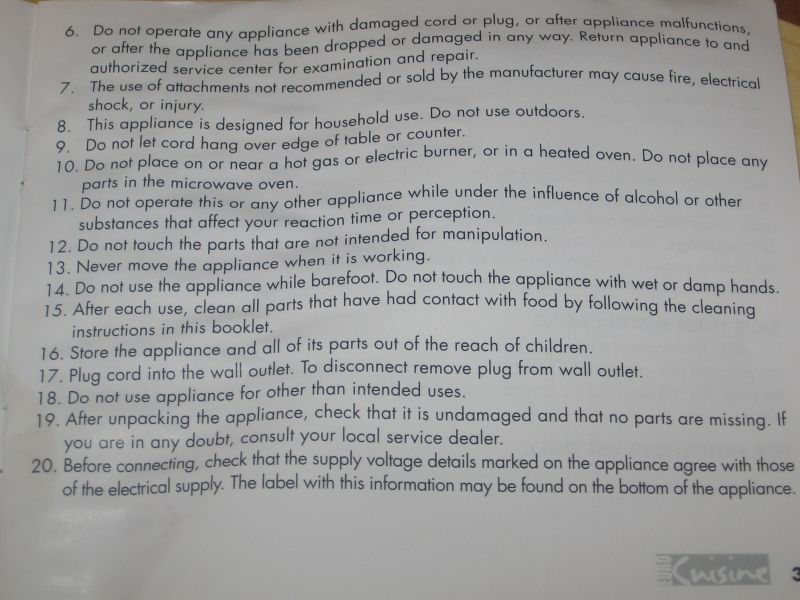
There are 24 initial instructions (isn’t this just heated milk inoculated with a starter?); it goes on for 3 pages. The first instruction (and the only one in bold letters) says: READ THESE INSTRUCTIONS. I have to admit I wasn’t having a problem until I came to #11 (click on the image below if you have difficulty reading it). It was in the evening, and as is often the case I had a glass of red wine (another fermented food) in my hand while I was reading . Nonetheless, I managed to make the yogurt fine (heated the milk and added the starter) even though my reaction time and perception may have been altered. If you want to learn more about fermented foods click here.


>My New Yogurt Maker (and its 3 pages of warnings)
>I have been interested in naturally fermented foods for about ten years…since the first time my sourdough starter seemingly and magically came to life; I was so inspired I built a small brick oven in the backyard of a previous home. Since then I’ve moved on to sauerkraut (and kim chi), pickled vegetables, and yogurt. What I enjoy about these foods is their ancientness (is that a word?) and also their health benefits. What I also like about them (besides consuming them) is “making” them, and I use quotes around t he word making because we don’t actually make them, we just provide the correct conditions…fermented foods almost make themselves.
Anyhow, I received my new yogurt maker in the mail yesterday (click here to see it), and it works great. It is basically an incubator (warmer) of sorts; meaning you heat the milk then add the starter and the yogurt maker keeps it warm all night, which allows the good bacteria to grow.
My first batch came out excellent…the flavor was tangy and nutty at the same time, and the yogurt was thick enough that a spoon would stand in it. So I have no problem with the appliance itself…it works fine. The problem I have is with it’s over-cautious instructions.
There are 24 initial instructions (isn’t this just heated milk inoculated with a starter?); it goes on for 3 pages. The first instruction (and the only one in bold letters) says: READ THESE INSTRUCTIONS. I have to admit I wasn’t having a problem until I came to #11 (click on the image below if you have difficulty reading it). It was in the evening, and as is often the case I had a glass of red wine (another fermented food) in my hand while I was reading . Nonetheless, I managed to make the yogurt fine (heated the milk and added the starter) even though my reaction time and perception may have been altered. If you want to learn more about fermented foods click here.
Ernest Was A Bike Advocate
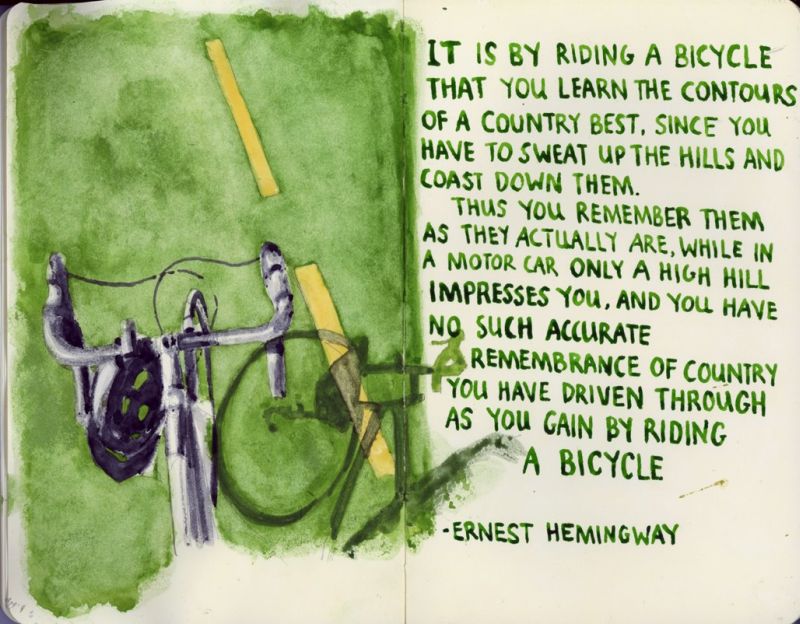
I can’t remember which of Ernest Hemingway’s books this quote is from but I remember reading it in one of them. When I was an impressionable young man his writing inspired me on many levels. It (his writing and the lives portrayed in his books…particularly The Sun Also Rises and A Movable Feast) is simplicity at it’s finest. Anyhow, I came across this picture and thought I’d share it.


>Ernest Was A Bike Advocate
>I can’t remember which of Ernest Hemingway’s books this quote is from but I remember reading it in one of them. When I was an impressionable young man his writing inspired me on many levels. It (his writing and the lives portrayed in his books…particularly The Sun Also Rises and A Movable Feast) is simplicity at it’s finest. Anyhow, I came across this picture and thought I’d share it.
100% Whole Wheat Bread
For those of you who are regular readers of this blog you know that I enjoy making bread…and that I’m an open advocate of incorporating homemade bread into you’re everyday life…it is not difficult or laborious (it’s quite the opposite, actually…it’s rewarding). I’ve also been attempting to make healthier breads these last few years (whole grains and whole wheat) but at the same time keep the integrity of an artisan loaf (meaning not one that is so heavy you could use it as a brick). Click here to see a recipe for a previous post on Ezekiel Bread.
One key method I learned, a pivotal point really, or a new paradigm you might say, was when I read Peter Reinhart’s book, Whole Grained Breads, and how he soaks whole wheat flour for a few hours (or overnight) to soften it. This method was without doubt (to me) ground breaking. By soaking the flour overnight the flour becomes soft and workable…and it produces a light loaf that is comprised entirely of whole wheat flour.
I’ve created a simplified variation, and it goes something like this: Soak some of the flour with water, yeast, and honey to make a starter (or poolish), and in another bowl soak the bulk of the flour with the other ingredients. In a few hours, or the next day, mix the two bowls together and knead them, let it rise, and bake it. The outcome is a delicious and wholesome bread. It makes incredible sandwiches and toast, and it tastes so healthy you’ll just want to eat it spread with butter or dipped in olive oil. I made a large batch at work recently (9 loaves); here it is in pictures (click here to see an earlier post I wrote on 100% whole wheat bread). Following the pictures is a smaller recipe that make two loaves.
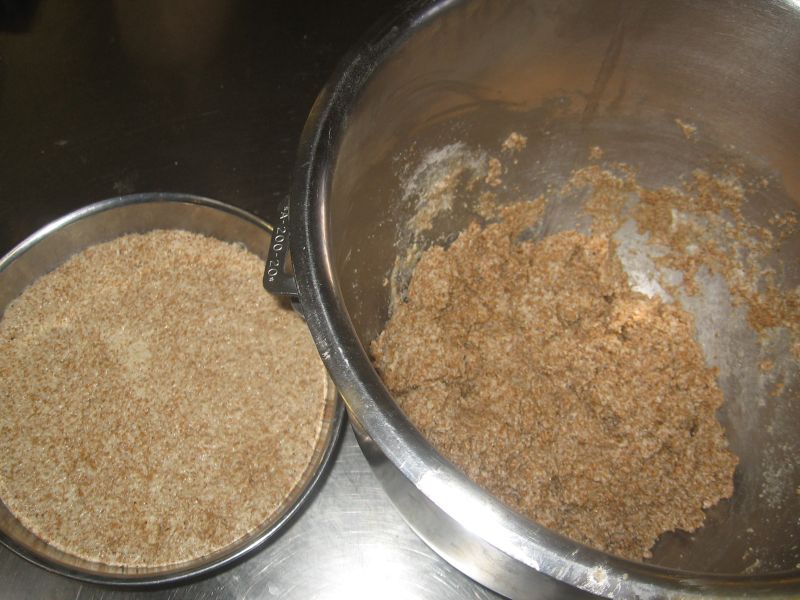
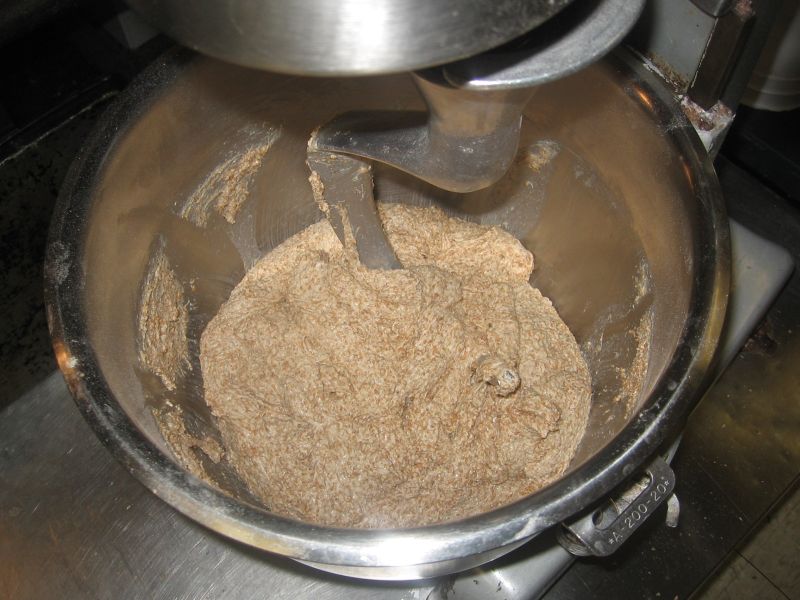
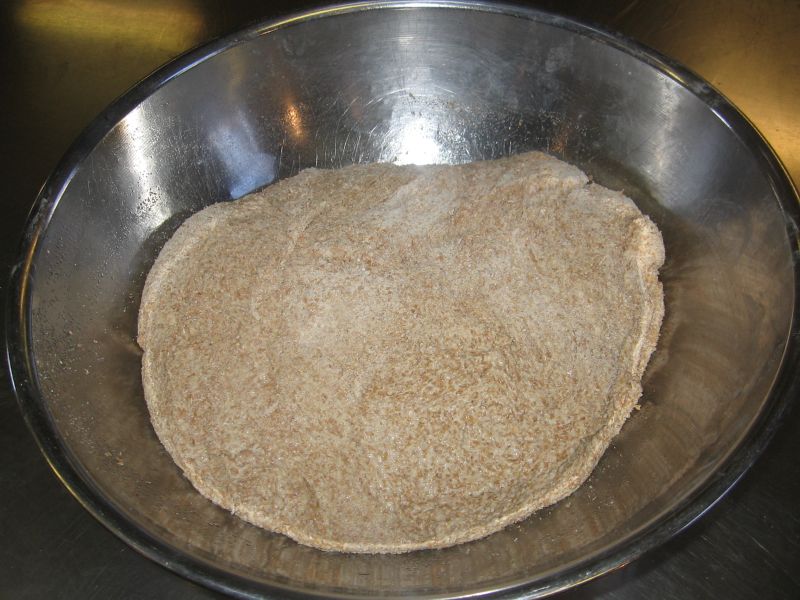
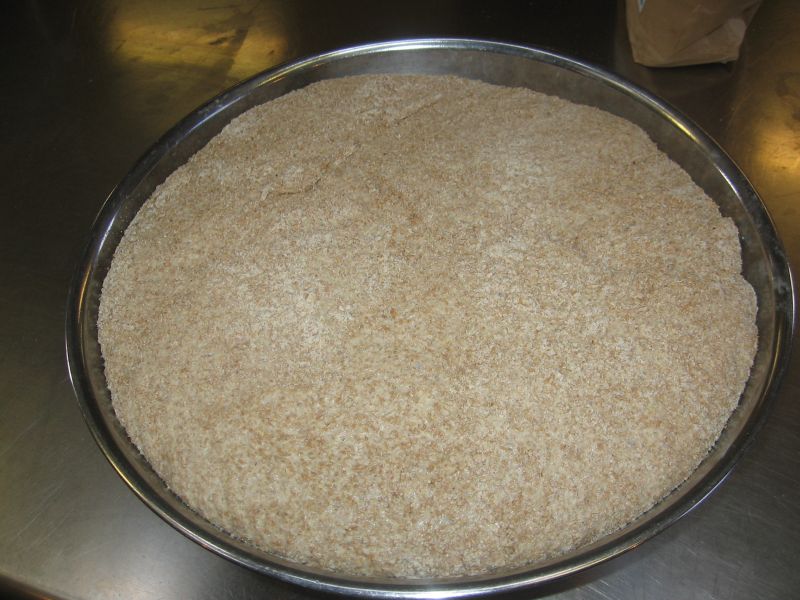
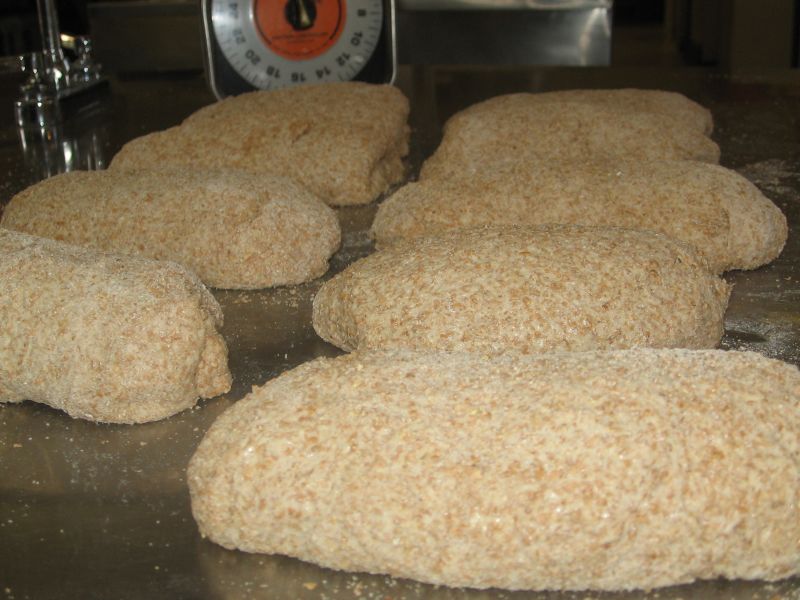
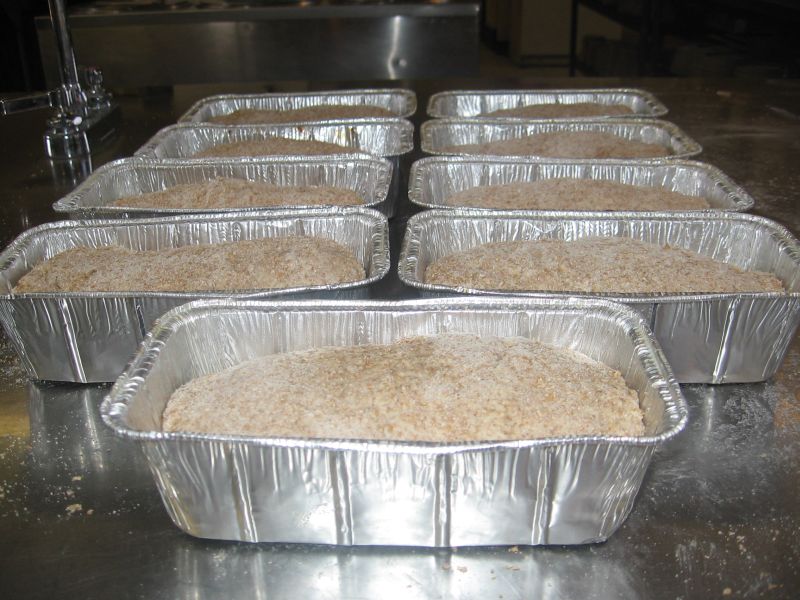
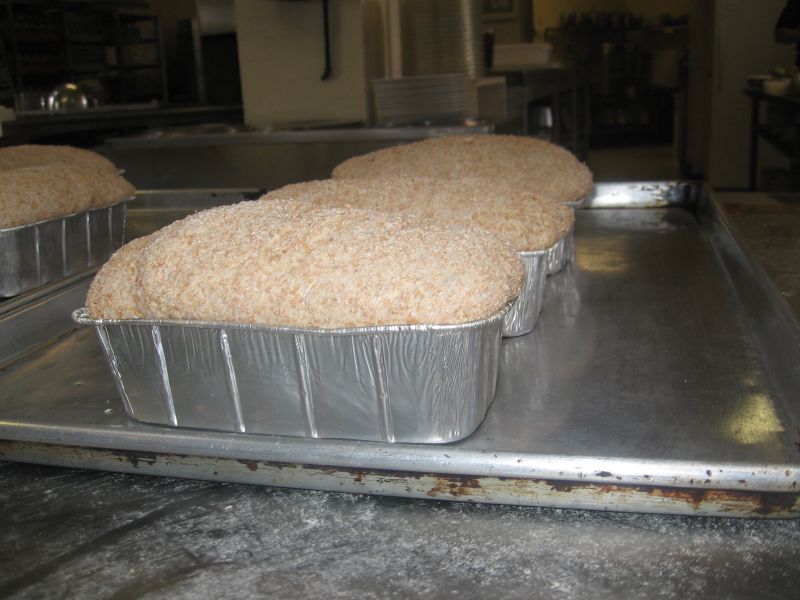
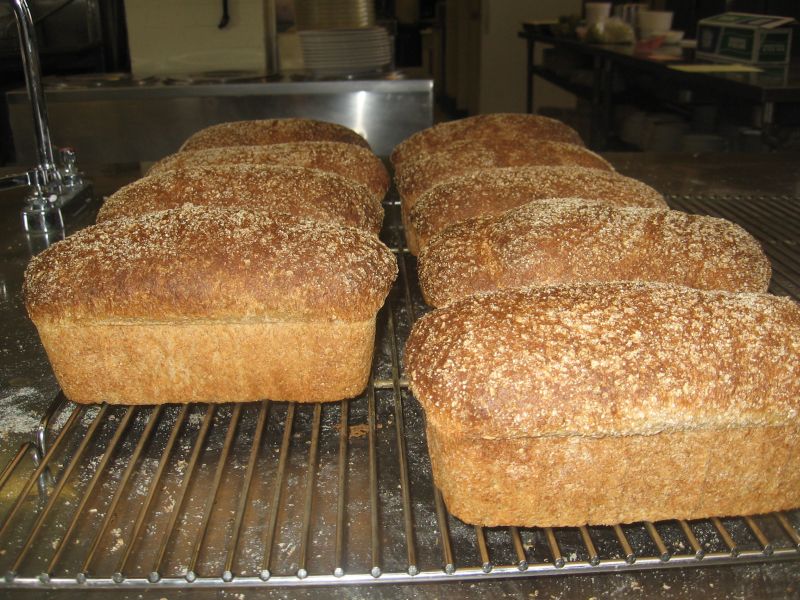
100% Whole Wheat Bread
Makes 2 loaves
6 cups whole wheat flour, divided
2 1/4 cups water, divided
1 cup plain yogurt
2 teaspoons kosher salt
1/4 cup olive oil
1/4 cup honey
3 teaspoons instant yeast, divided
Separate the ingredients in two bowls using this ratio: In one bowl combine 4 cups of flour, 1 1/4 cups water, along with all of the yogurt and salt. Stir it just until combined; cover with plastic wrap and set aside. In a second bowl, combine the remaining 2 cups flour and 1 cup water with the olive oil, honey, and 2 teaspoons of yeast. Stir it just until combined; cover with plastic wrap and set aside. Allow the bowls to rest for at least an hour, but up to 12.
Add the remaining teaspoon yeast and the contents of both bowls to an upright electric mixer fitted with a dough hook. Knead the dough on medium speed for about 8 minutes, then cover with plastic wrap and allow to rise for one hour.
Transfer the dough to a work surface, cut it into two pieces, gently shape it into loaves, and place the loaves into oiled loaf pans. Cover with plastic wrap and allow to rise for 45 minutes. Preheat an oven to 400F.
Bake the bread for about 30 minutes, or until golden brown and sounds hollow when tapped on. Remove the bread from their pans and allow to cool for 10 minutes before slicing.

>100% Whole Wheat Bread
>For those of you who are regular readers of this blog you know that I enjoy making bread…and that I’m an open advocate of incorporating homemade bread into you’re everyday life…it is not difficult or laborious (it’s quite the opposite, actually…it’s rewarding). I’ve also been attempting to make healthier breads these last few years (whole grains and whole wheat) but at the same time keep the integrity of an artisan loaf (meaning not one that is so heavy you could use it as a brick). Click here to see a recipe for a previous post on Ezekiel Bread.
One key method I learned, a pivotal point really, or a new paradigm you might say, was when I read Peter Reinhart’s book, Whole Grained Breads, and how he soaks whole wheat flour for a few hours (or overnight) to soften it. This method was without doubt (to me) ground breaking. By soaking the flour overnight the flour becomes soft and workable…and it produces a light loaf that is comprised entirely of whole wheat flour.
I’ve created a simplified variation, and it goes something like this: Soak some of the flour with water, yeast, and honey to make a starter (or poolish), and in another bowl soak the bulk of the flour with the other ingredients. In a few hours, or the next day, mix the two bowls together and knead them, let it rise, and bake it. The outcome is a delicious and wholesome bread. It makes incredible sandwiches and toast, and it tastes so healthy you’ll just want to eat it spread with butter or dipped in olive oil. I made a large batch at work recently (9 loaves); here it is in pictures (click here to see an earlier post I wrote on 100% whole wheat bread). Following the pictures is a smaller recipe that make two loaves.
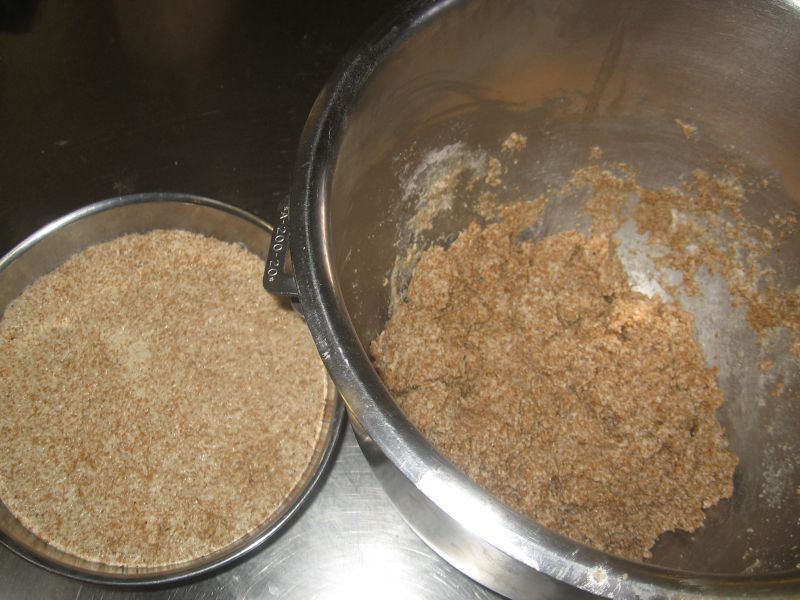
100% Whole Wheat Bread
Makes 2 loaves
6 cups whole wheat flour, divided
2 1/4 cups water, divided
1 cup plain yogurt
2 teaspoons kosher salt
1/4 cup olive oil
1/4 cup honey
3 teaspoons instant yeast, divided
Separate the ingredients in two bowls using this ratio: In one bowl combine 4 cups of flour, 1 1/4 cups water, along with all of the yogurt and salt. Stir it just until combined; cover with plastic wrap and set aside. In a second bowl, combine the remaining 2 cups flour and 1 cup water with the olive oil, honey, and 2 teaspoons of yeast. Stir it just until combined; cover with plastic wrap and set aside. Allow the bowls to rest for at least an hour, but up to 12.
Add the remaining teaspoon yeast and the contents of both bowls to an upright electric mixer fitted with a dough hook. Knead the dough on medium speed for about 8 minutes, then cover with plastic wrap and allow to rise for one hour.
Transfer the dough to a work surface, cut it into two pieces, gently shape it into loaves, and place the loaves into oiled loaf pans. Cover with plastic wrap and allow to rise for 45 minutes. Preheat an oven to 400F.
Bake the bread for about 30 minutes, or until golden brown and sounds hollow when tapped on. Remove the bread from their pans and allow to cool for 10 minutes before slicing.
Things That Can Be Carried On A Bike (#13)
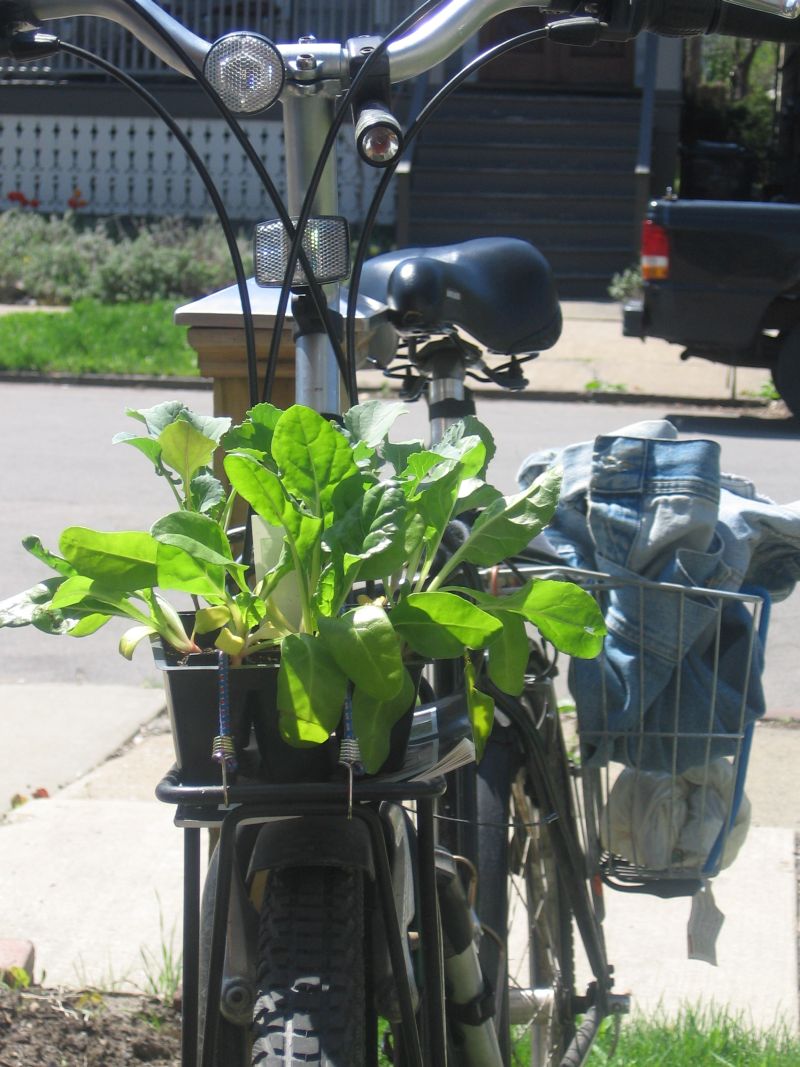 12 small vegetable plants (6 broccoli, 6 Swiss chard)
6 galvanized pipe fittings
2 magazines
1 pint spackling compound
1 jean jacket

>Things That Can Be Carried On A Bike (#13)
>12 small vegetable plants (6 broccoli, 6 Swiss chard)
6 galvanized pipe fittings
2 magazines
1 pint spackling compound
1 jean jacket
Fish, Green Beans, and Pasta: Variation On Two Themes

One of the benefits of being a professional cook is having the ability to make something out of almost anything that is at hand. You’ve probably seen those “basket tests” that are shown on silly cooking shows (where a chef is handed a basket of odd and sometimes obscure ingredients and is expected to a make a full meal out of it)…well, that’s basically what it’s like when I open my fridge some evenings…I never know what I’ll find (I really do need to go grocery shopping more often). At any rate, I made a cross between two dishes span two nationalities (variation on two themes). I had some fish and pasta so I made a pasta fra diavolo, and I had some green beans so I cut them in half and stewed them in the tomato sauce (like Lebanese style green beans) before adding the fish. I loaded it with garlic and hot peppers…needles to say it was delicious. You can see an earlier post regarding pasta fra diavolo (and a link to a recipe) by clicking here.

>Fish, Green Beans, and Pasta: Variation On Two Themes
>
One of the benefits of being a professional cook is having the ability to make something out of almost anything that is at hand. You’ve probably seen those “basket tests” that are shown on silly cooking shows (where a chef is handed a basket of odd and sometimes obscure ingredients and is expected to a make a full meal out of it)…well, that’s basically what it’s like when I open my fridge some evenings…I never know what I’ll find (I really do need to go grocery shopping more often). At any rate, I made a cross between two dishes span two nationalities (variation on two themes). I had some fish and pasta so I made a pasta fra diavolo, and I had some green beans so I cut them in half and stewed them in the tomato sauce (like Lebanese style green beans) before adding the fish. I loaded it with garlic and hot peppers…needles to say it was delicious. You can see an earlier post regarding pasta fra diavolo (and a link to a recipe) by clicking here.
An Oldie But A Goodie

>An Oldie But A Goodie
>
I’ll Admit it (Reluctantly)
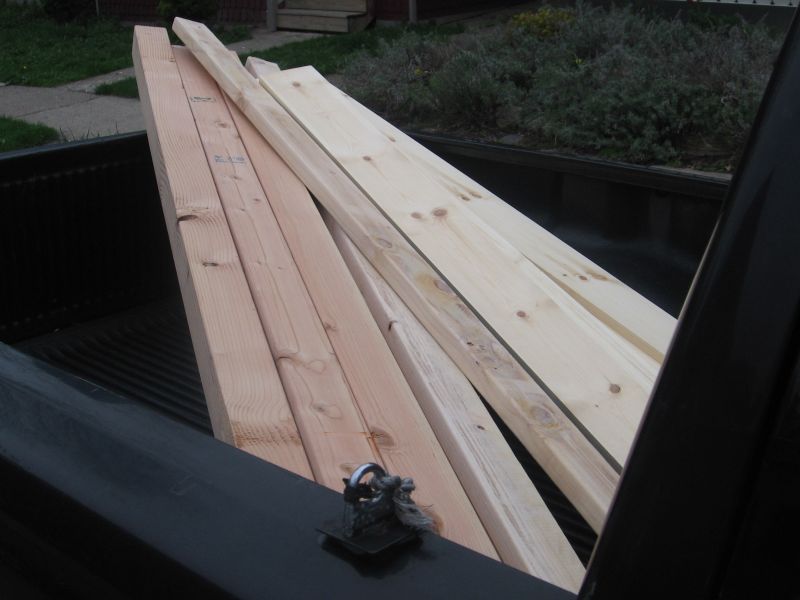 This post could easily be titled “Things That Cannot Be Carried On A Bike,” but I don’t entirely think it’s true. At any rate, I’ll admit a couple things: I’ll admit that I do use my small truck occasionally (and my middle aged knees find a secret relief), and I’ll also admit that I (occasionally) know my limits. I have carried lumber on a bike in the past (click here and here to see it), but this was simply too much at one time. Though when I was stuck in rush hour traffic this evening I really wished I was on my bike coasting through the traffic. Hauling this much lumber by bike is not physically impossible, but you have to be prepared for it (take a look at these cargo trailers)

>I’ll Admit it (Reluctantly)
>This post could easily be titled “Things That Cannot Be Carried On A Bike,” but I don’t entirely think it’s true. At any rate, I’ll admit a couple things: I’ll admit that I do use my small truck occasionally (and my middle aged knees find a secret relief), and I’ll also admit that I (occasionally) know my limits. I have carried lumber on a bike in the past (click here and here to see it), but this was simply too much at one time. Though when I was stuck in rush hour traffic this evening I really wished I was on my bike coasting through the traffic. Hauling this much lumber by bike is not physically impossible, but you have to be prepared for it (take a look at these cargo trailers)
Things That Can Be Carried On A Bike (#12)
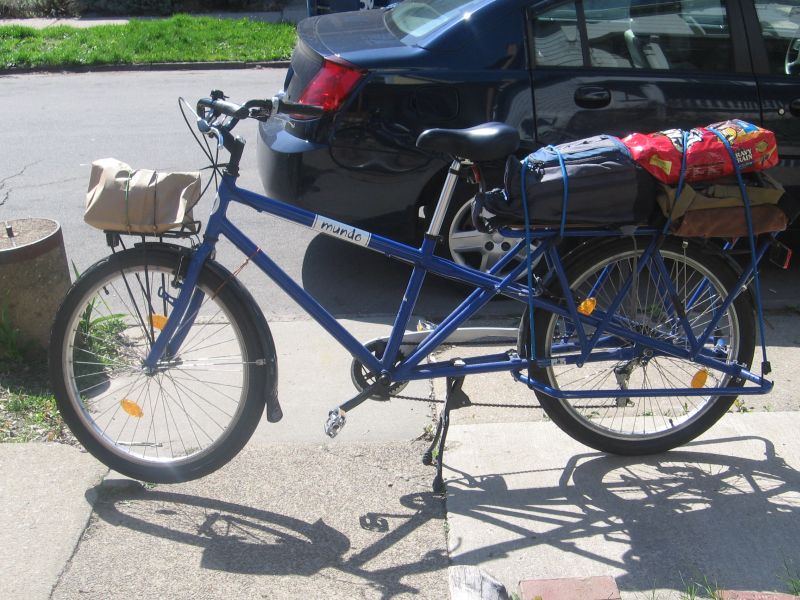 A large shoulder bag containing a laptop, an extra mouse, and a 25′ extension cord.
A small shoulder bag with a sketchbook, datebook, pens, a couple books and other miscellanea.
A backpack containing almost 30 pounds of my son’s school books/supplies.
An 8-pound bag of dog food.
A bag with 5-pounds of whole wheat flour.
A 14-year-old kid (he sat on his backpack).
The driver of the bike (me…obviously).

 Urban Simplicty