For the Love of Flavor

“How embarrassing… a house full of condiments and no food.” 
Narrator, Fight Club

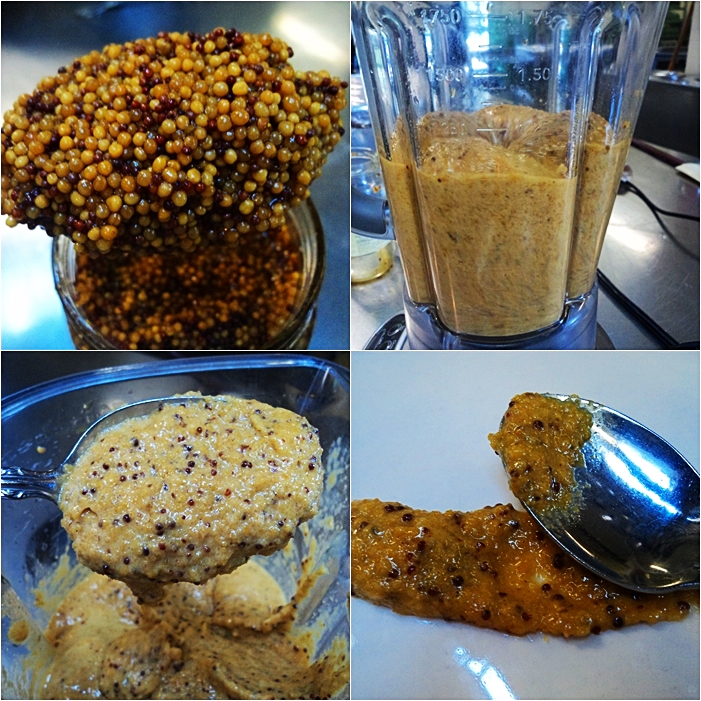
Condiments can make even the most mundane foods taste great, and they are so plentiful and inexpensive that they’re rarely made at home these days…somewhat of a lost art, one could suppose. These two recipes are perfect examples: course-grained honey-mustard, and pink (beet) horseradish. Both are so simple to make and will last for months in the fridge.

To read a short story about condiments in general–including they’re history, lore, uses, and additional recipes–click here. To read another short story about ketchup (and yes it has a really interesting past) and how to make it–including a few variations–click here.

Honey-Mustard
Makes about 2 1/2 cups

1 cup yellow mustard seeds
2 tablespoons brown mustard seeds
1/4 cup honey
1 cup white wine vinegar
1/4 cup white wine
1 teaspoon turmeric 

Combine all of the ingredients in a glass jar and allow to soak at room temperature for about two days. Transfer to a blender and puree to desired consistency. Return to the glass jar and refrigerate.

Pink Prepared Horseradish
Makes about 2 1/2 cups

1 pound horseradish root, peeled
1 small beet, peeled
3/4 cup white wine vinegar
1/2 teaspoon kosher salt

Grate the horseradish and beet, then transfer them to a food processor. Add the vinegar and salt and puree until desired consistency. Transfer to a glass jar and refrigerate.

What Tips Do You Have (I’d like to know)

A couple things. Firstly, no that is not a current picture; it’s one I took last winter. Though I live in a snowy area of the world it has not snowed yet (and hopefully won’t for at least a month or two). The other thing is this. I am currently writing a short article which will be published in the dead of winter. It is an article regarding riding a bicycle throughout the winter, specifically tips on how to do it when it is cold and snowy. I know that many of the readers of this blog are bike riders, and many ride year-round. I would love to hear what you have to say in a sentence or two…not so much common sense things like wear layers of clothing and cover your extremities, use caution at intersections, or have good tires, but specific things that you do that you think others may benefit from. I would like to quote you, actually; just a sentence or two with your first name (or full name if you’d like) and from where you are writing (and ride). Once the article is in print I will put a link to it on this blog (and likely on my facebook page). If you are interested you can leave your comment in the comments section of this post or email it directly to me at buffalocook [at] gmail [dot] com. If you would like to offer your tip but don’t want to be quoted in the story that’s cool (pun intended) just state this when you comment. Thanks in advance; I’m looking forward to hearing what others have to say and offer. Peace.

What Tips Do You Have (I’d like to know)

A couple things. Firstly, no that is not a current picture; it’s one I took last winter. Though I live in a snowy area of the world it has not snowed yet (and hopefully won’t for at least a month or two). The other thing is this. I am currently writing a short article which will be published in the dead of winter. It is an article regarding riding a bicycle throughout the winter, specifically tips on how to do it when it is cold and snowy. I know that many of the readers of this blog are bike riders, and many ride year-round. I would love to hear what you have to say in a sentence or two…not so much common sense things like wear layers of clothing and cover your extremities, use caution at intersections, or have good tires, but specific things that you do that you think others may benefit from. I would like to quote you, actually; just a sentence or two with your first name (or full name if you’d like) and from where you are writing (and ride). Once the article is in print I will put a link to it on this blog (and likely on my facebook page). If you are interested you can leave your comment in the comments section of this post or email it directly to me at buffalocook [at] gmail [dot] com. If you would like to offer your tip but don’t want to be quoted in the story that’s cool (pun intended) just state this when you comment. Thanks in advance; I’m looking forward to hearing what others have to say and offer. Peace.

Cycling For Everyone

I love this video. It’s a new inspirational piece put out by the Dutch Cycling Embassy. It offers first a brief history of cycling in Holland and then what is happening today regarding cycling in their beautiful country…mostly how cycling is integrated into daily life. Living in the automobile-centric U.S. I’d be fibbing if I said I wasn’t a bit jealous. Anyhow, it really is a nice and inspiring video to watch.

Cycling For Everyone

I love this video. It’s a new inspirational piece put out by the Dutch Cycling Embassy. It offers first a brief history of cycling in Holland and then what is happening today regarding cycling in their beautiful country…mostly how cycling is integrated into daily life. Living in the automobile-centric U.S. I’d be fibbing if I said I wasn’t a bit jealous. Anyhow, it really is a nice and inspiring video to watch.

La Pomme

“Surely the apple is the noblest of fruits.”
— Henry David Thoreau

For additional recipes and to read a story about apples–with practical information, history, and lore–click here.

Old Fashioned AppleButter
Yield: 2 cups
6-7 large apples
1-1/4 cups brown sugar
1/2 cup water
Peel, core and quarter the apples;discard the peels and cores. Combine the peeled apple pieces in aheavy-bottomed pot, preferably one with a non-stick coating. Coverthe pot and bring the liquid to a simmer and cook the apples for 10minutes. Transfer the cooked apple mixture to a blender or foodprocessor and process until smooth. Transfer the purée back to thesame pot.
Cook the apple purée over a low flamefor 1 hour, or until it has reduced and become dark in color and theconsistency of peanut butter. During the cooking process stir theapple mixture often to avoid scorching. Transfer the apple butter toa clean jar and refrigerate it. After it has cooled cover it tightly.Use apple butter as a spread on toasted bread or as an ingredient inbaked goods or sauces.
Bratwurst Braisedwith Onions and Apple Butter
Yield: 4 servings
2 tablespoons vegetable oil
1-1/2 pounds fresh bratwurst
2 small onions, peeled andsliced thinly
2 cups chicken broth
1/2 cup apple butter
1/2 teaspoon black pepper
1/2 teaspoon salt
1 tablespoon balsamic vinegar
Heat the oil over high heat in a heavyskillet. Add the bratwurst and cook them until they begin to brown.Sprinkle the onions around the sausage in the pan, turn the sausage,and stir the onions until both the sausage and onions are goldenbrown. Add the chicken stock and turn the heat down to a low simmer.Cover the pan and cook the sausage for 10 minutes. Stir in the applebutter, salt, pepper, and vinegar; cover the pan and cook the sausagefor another 10 minutes. Serve with mashed potatoes.

La Pomme

“Surely the apple is the noblest of fruits.”
— Henry David Thoreau

For additional recipes and to read a story about apples–with practical information, history, and lore–click here.

Old Fashioned AppleButter
Yield: 2 cups
6-7 large apples
1-1/4 cups brown sugar
1/2 cup water
Peel, core and quarter the apples;discard the peels and cores. Combine the peeled apple pieces in aheavy-bottomed pot, preferably one with a non-stick coating. Coverthe pot and bring the liquid to a simmer and cook the apples for 10minutes. Transfer the cooked apple mixture to a blender or foodprocessor and process until smooth. Transfer the purée back to thesame pot.
Cook the apple purée over a low flamefor 1 hour, or until it has reduced and become dark in color and theconsistency of peanut butter. During the cooking process stir theapple mixture often to avoid scorching. Transfer the apple butter toa clean jar and refrigerate it. After it has cooled cover it tightly.Use apple butter as a spread on toasted bread or as an ingredient inbaked goods or sauces.
Bratwurst Braisedwith Onions and Apple Butter
Yield: 4 servings
2 tablespoons vegetable oil
1-1/2 pounds fresh bratwurst
2 small onions, peeled andsliced thinly
2 cups chicken broth
1/2 cup apple butter
1/2 teaspoon black pepper
1/2 teaspoon salt
1 tablespoon balsamic vinegar
Heat the oil over high heat in a heavyskillet. Add the bratwurst and cook them until they begin to brown.Sprinkle the onions around the sausage in the pan, turn the sausage,and stir the onions until both the sausage and onions are goldenbrown. Add the chicken stock and turn the heat down to a low simmer.Cover the pan and cook the sausage for 10 minutes. Stir in the applebutter, salt, pepper, and vinegar; cover the pan and cook the sausagefor another 10 minutes. Serve with mashed potatoes.

Five Quotes from William Arthur Ward

If you can imagine it,
You can achieve it.
If you can dream it,
You can become it.
To make mistakes is human; to stumble is commonplace; to be able to laugh at yourself is maturity.
Leadership is based on inspiration, not domination; on cooperation, not intimidation.
It is wise to direct your anger towards problems — not people; to focus your energies on answers — not excuses.

Before you speak, listen.
Before you write, think.
Before you spend, earn.
Before you invest, investigate.
Before you criticize, wait.
Before you pray, forgive.
Before you quit, try.
Before you retire, save.
Before you die, give

Five Quotes from William Arthur Ward

If you can imagine it,
You can achieve it.
If you can dream it,
You can become it.
To make mistakes is human; to stumble is commonplace; to be able to laugh at yourself is maturity.
Leadership is based on inspiration, not domination; on cooperation, not intimidation.
It is wise to direct your anger towards problems — not people; to focus your energies on answers — not excuses.

Before you speak, listen.
Before you write, think.
Before you spend, earn.
Before you invest, investigate.
Before you criticize, wait.
Before you pray, forgive.
Before you quit, try.
Before you retire, save.
Before you die, give

Something I Saw Today

If you’ve been to this blog before you may be growing tired of me proclaiming the many benefits of bicycling (but then again, maybe not). Anyhow, I’ll again state the obvious. When you ride a bike you see things and are able to interact with the things and people you see that would be impossible to do if in a car (and yes, I still do own a car…I just don’t use it that often…put gas in it for the first time in 6 weeks yesterday). This above picture is a good example. I was out running errands this morning and stopped at the side of Hoyt Lake–a sort of urban oasis–for a quick respite. This could be anywhere, right? Beautiful. But directly behind me is the entrance to the Scajaquada Expressway which cuts through the heart of our city. Cars zipped by and gained speed as they entered the highway making it impossible to stop and enjoy this. I know because I have, in the past, been in one of those cars. But today I just sat for a minute and enjoyed the view. Click the image for a fuller view.

Something I Saw Today

If you’ve been to this blog before you may be growing tired of me proclaiming the many benefits of bicycling (but then again, maybe not). Anyhow, I’ll again state the obvious. When you ride a bike you see things and are able to interact with the things and people you see that would be impossible to do if in a car (and yes, I still do own a car…I just don’t use it that often…put gas in it for the first time in 6 weeks yesterday). This above picture is a good example. I was out running errands this morning and stopped at the side of Hoyt Lake–a sort of urban oasis–for a quick respite. This could be anywhere, right? Beautiful. But directly behind me is the entrance to the Scajaquada Expressway which cuts through the heart of our city. Cars zipped by and gained speed as they entered the highway making it impossible to stop and enjoy this. I know because I have, in the past, been in one of those cars. But today I just sat for a minute and enjoyed the view. Click the image for a fuller view.

Things That Can Be Carried on a Bike (#356), a Recipe, and My Morning Commute

Things On The Bike: A plastic bucket with raw bread dough, a canvas book bag containing various things (including–oddly–a couple tulip bulbs), and a Rolling Stone magazine.

My Morning Commute: The lower of the above photos is the view I see from my handlebars on my morning commute nearly every morning; it’s at this intersection. I use the word loosely because it’s not much of a commute, per se, it’s probably not quite a mile from my house each way. But this is something I’ve planned over the past decade…to have most everything within a few mile radius. But that photo is what I see almost every day, no matter what the weather may bring. This morning was beautiful…the sun was peeking from behind the clouds, it was unseasonably warm, the Bubble Man was doing his thing, and the smell of Cheerios permeated the air; as I waited at the light I marveled at this. And while I was waiting I could see the person in the vehicle in front of me was agitated and talking on a cell phone while bass blared from his auto’s speakers. I was  really glad to be on a bicycle behind this person instead of in front of them. The light changed and the couple of cars ahead of me tried to speed away but on these narrow streets they can’t so the person looked even more frustrated at the next stop light. And as I pedaled the short way to work I also marveled at the truly miraculous microcosm I was carrying on the front rack of my bike, what we call bread dough. And this brings me to the next topic.

A Quick Recipe: I used the recipe at the end of this post but also added a tablespoon of  vital wheat gluten and rolled the dough in cornmeal after shaping it. I also shaped the loaves into boules, rather than baking them in loaf pans (this is the reason I added the wheat gluten). Anyhow, to learn more about making this bread, click here, and to see plenty of pictures of bread being made, click here.


100% Whole Wheat Bread

Makes 2 loaves

2 cups whole wheat flour
1 cup water
2 teaspoons instant yeast
————————
4 cups whole wheat flour
1 3/4 cups water
————————
1/4 cup honey
1/4 cup olive oil
3 teaspoons instant yeast
3 teaspoons kosher salt

In one bowl make a preferment by combining 2 cups of whole wheat flour with 2/3 cups water and 2 teaspoons of instant yeast. Begin the autolyse in another bowl by combining 4 cups of whole wheat flour and 1 1⁄2 cups water. Stir each bowl just enough to combine the ingredients, taking care not to get yeast into the bowl with the autolyse. If the contents in either of the bowls need more water, add a small amount. Cover both bowls and allow to rest and ferment for 30-90 minutes, during which time the preferment will begin it’s job multiplying yeast and fermenting flour, and the autolyse will soak the grain, swelling the gluten.
After an hour or so, combine the ingredients from both bowls into the bowl of an upright mixer fitted with a dough hook. Add the honey, olive oil, salt, and 3 teaspoons of yeast (add the yeast and salt on opposite sides of the bowl). Knead the dough on medium speed for about 8 minutes. Place the dough in a lightly oiled container, cover it loosely, and allow to ferment for 1-2 hours, or until doubled in bulk. Deflate the dough and allow it to ferment an additional 30 minutes.
Turn the dough out onto a floured work surface and cut it into 2 or 3 pieces. Shape into loaves and place into lightly oiled pans. Loosely cover the loaves with plastic wrap and allow to ferment for 30-60 minutes, or until double in size and when gently touched with a fingertip an indentation remains.
Bake the breads for about 30-40 minutes, adding steam to the oven a few times (either with ice cubes or a spray bottle) and rotating the breads every ten minutes. The breads are done when they are dark brown and sound hollow when tapped upon. Remove the breads from their pans and allow them to cook on a wire rack for at least 10 minutes before slicing.

Things That Can Be Carried on a Bike (#356), a Recipe, and My Morning Commute

Things On The Bike: A plastic bucket with raw bread dough, a canvas book bag containing various things (including–oddly–a couple tulip bulbs), and a Rolling Stone magazine.

My Morning Commute: The lower of the above photos is the view I see from my handlebars on my morning commute nearly every morning; it’s at this intersection. I use the word loosely because it’s not much of a commute, per se, it’s probably not quite a mile from my house each way. But this is something I’ve planned over the past decade…to have most everything within a few mile radius. But that photo is what I see almost every day, no matter what the weather may bring. This morning was beautiful…the sun was peeking from behind the clouds, it was unseasonably warm, the Bubble Man was doing his thing, and the smell of Cheerios permeated the air; as I waited at the light I marveled at this. And while I was waiting I could see the person in the vehicle in front of me was agitated and talking on a cell phone while bass blared from his auto’s speakers. I was  really glad to be on a bicycle behind this person instead of in front of them. The light changed and the couple of cars ahead of me tried to speed away but on these narrow streets they can’t so the person looked even more frustrated at the next stop light. And as I pedaled the short way to work I also marveled at the truly miraculous microcosm I was carrying on the front rack of my bike, what we call bread dough. And this brings me to the next topic.

A Quick Recipe: I used the recipe at the end of this post but also added a tablespoon of  vital wheat gluten and rolled the dough in cornmeal after shaping it. I also shaped the loaves into boules, rather than baking them in loaf pans (this is the reason I added the wheat gluten). Anyhow, to learn more about making this bread, click here, and to see plenty of pictures of bread being made, click here.


100% Whole Wheat Bread

Makes 2 loaves

2 cups whole wheat flour
1 cup water
2 teaspoons instant yeast
————————
4 cups whole wheat flour
1 3/4 cups water
————————
1/4 cup honey
1/4 cup olive oil
3 teaspoons instant yeast
3 teaspoons kosher salt

In one bowl make a preferment by combining 2 cups of whole wheat flour with 2/3 cups water and 2 teaspoons of instant yeast. Begin the autolyse in another bowl by combining 4 cups of whole wheat flour and 1 1⁄2 cups water. Stir each bowl just enough to combine the ingredients, taking care not to get yeast into the bowl with the autolyse. If the contents in either of the bowls need more water, add a small amount. Cover both bowls and allow to rest and ferment for 30-90 minutes, during which time the preferment will begin it’s job multiplying yeast and fermenting flour, and the autolyse will soak the grain, swelling the gluten.
After an hour or so, combine the ingredients from both bowls into the bowl of an upright mixer fitted with a dough hook. Add the honey, olive oil, salt, and 3 teaspoons of yeast (add the yeast and salt on opposite sides of the bowl). Knead the dough on medium speed for about 8 minutes. Place the dough in a lightly oiled container, cover it loosely, and allow to ferment for 1-2 hours, or until doubled in bulk. Deflate the dough and allow it to ferment an additional 30 minutes.
Turn the dough out onto a floured work surface and cut it into 2 or 3 pieces. Shape into loaves and place into lightly oiled pans. Loosely cover the loaves with plastic wrap and allow to ferment for 30-60 minutes, or until double in size and when gently touched with a fingertip an indentation remains.
Bake the breads for about 30-40 minutes, adding steam to the oven a few times (either with ice cubes or a spray bottle) and rotating the breads every ten minutes. The breads are done when they are dark brown and sound hollow when tapped upon. Remove the breads from their pans and allow them to cook on a wire rack for at least 10 minutes before slicing.